Text by Tom White. Photos by Muhammad Fadli.

With all the talk of climate change, ESG (environmental, social, and corporate governance), green economies, net zero, and the energy transition — shifting from fossil fuels to renewable sources such as solar and wind for a cleaner and more sustainable future — you would be forgiven for thinking that governments and corporations are engaged in actively addressing these issues. On the ground, the story is often very different.
Three recent articles photographed by Indonesian photographer Muhammad Fadli expose the reality of the situation:
- The dirty practices of a Zug-based mining group in Borneo (Public Eye)
- The race to put indigenous land on the map (Rest of World)
- As EVs surge, so does nickel mining’s death toll (Rest of World)
Resource extraction—removing food, fuel and other material from the Earth for human use—and its associated environmental and social damage, has never been higher. How does this tally with the goals of the so-called green transition?
There is still significant obstruction from some quarters. Fossil fuel companies, commodities traders, politicians, government representatives and many others will declare that fossil fuels are necessary to lift people out of energy poverty, increase living standards for the world’s poorest, and fill renewable energy gaps “when the wind doesn’t blow and the sun doesn’t shine.”
While increased energy production is necessary, and has improved lives by some metrics, it has come at great cost to the environment. We are also failing to engage properly in conversations about what “raising living standards” actually means. Fossil fuel production has turned our societies into ones which over-produce and over-consume, driven—beyond need—by the profit motive. This is unsustainable.
Coal, Contamination, and Land Grabs in Kalimantan

In Kalimantan, on the Indonesian side of Borneo, Muhammad Fadli and writer Adrià Buddy Carbó reveal how coal mining literally gouges out indigenous community connections:
In Tumbang Olong, despite the pinang that discolours your gums and the sweetness of the tea that coats your mouth, tongues quickly loosen as soon as people hear the acronym ‘BP’, which is used here to refer to Borneo Prima.
The mining group’s bulldozers started by razing Mr Azis’ 300 rubber trees ‘with no consultation or prior notice’. They then seized the land where the soul of Dewi Sertika’s aunt has been laid to rest. The mine ended up contaminating the water source of the village’s first inhabitants, Manan and his wife Ilum, which supplies the whole community.
Source
In reporting on Dewi Sertika’s struggle with the mining company over the rights to the land she lives on, Fadli photographed Sertika’s deceased aunt’s tokohan, carved posts where the Dayak believe the souls of their ancestors rest.

It is a belief so deeply embedded that company contractors refused to touch the tokohan, even as they took her land. This anecdote— and the photograph—is a powerful symbol of the wider struggles between corporate interests and communities on the ground.
Mapping Land Rights in Sarawak
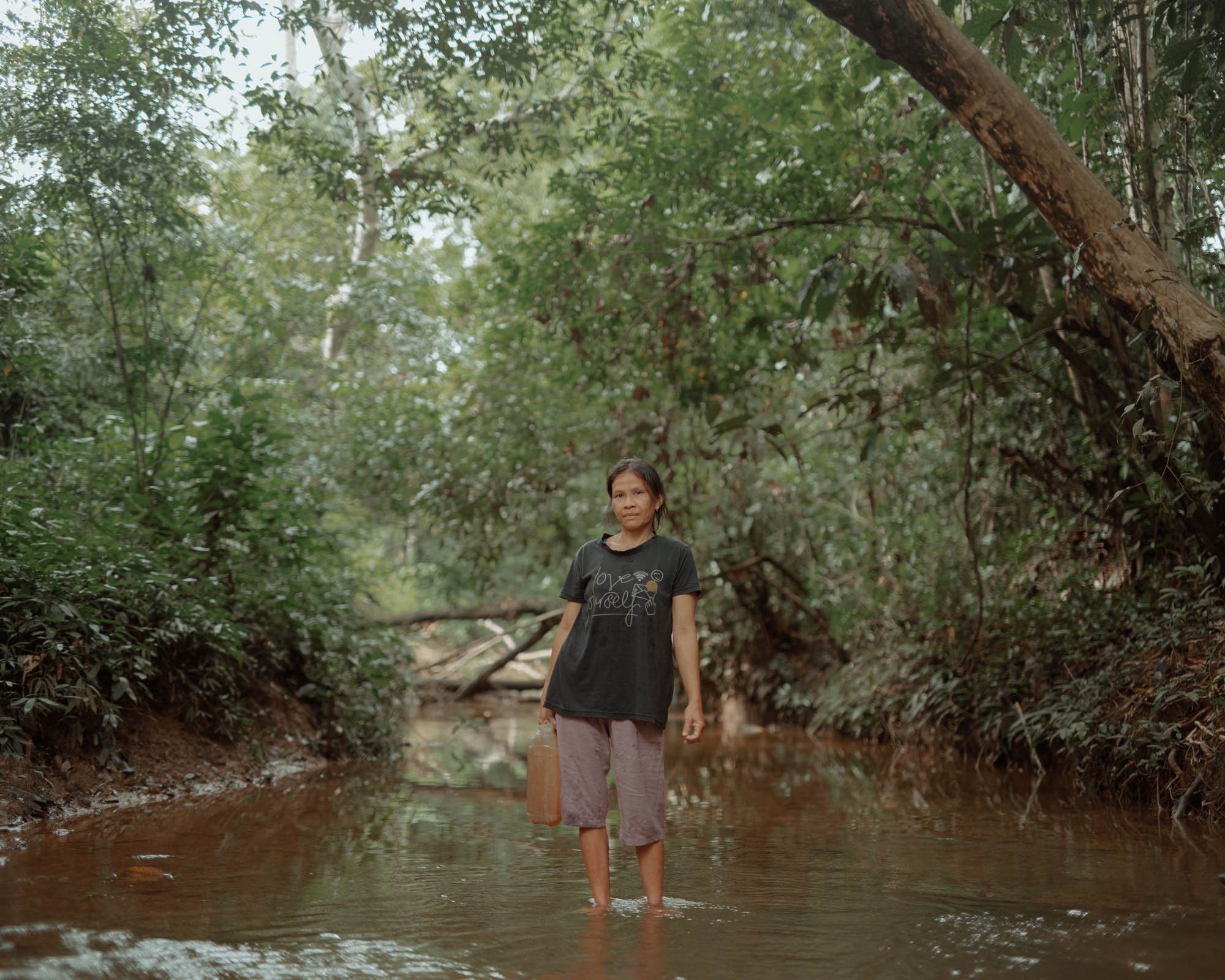
On the Malaysian side of Borneo, we hear how land, and the connection to it, is again at the heart of the conflict. Locals in Sarawak are beginning to use modern mapping techniques to document their claims to the land, and resist encroaching palm oil companies. The article’s personal testimonies and Fadli’s portraits bring us into the heart of the clash between industry and locals on the front line of resisting environmental destruction.

I saw such resistance myself on a trip to Borneo in 2016 as part of a research cluster exploring environmental issues across Asia. I photographed several Dayak communities along the Baram River who were trying to prevent the construction of a hydropower dam that would have flooded a number of villages. These indigenous communities mounted legal challenges, physical blockades, and proposed alternative micro hydro projects. As a result of such campaigns, and questions over the necessity of such a project, plans for this particular dam are currently on hold.

Today, many of us fret vocally about lost connections to the natural world, but often ignore the idea that our comfort comes at the expense of others. Complicating this is the fact that we need to continue to mine the raw materials used to produce the batteries, hardware and infrastructure of a world powered by renewable energy. This means we cannot entirely eliminate resource extraction.
Workers’ Dismal Conditions in Sulawesi
The third story opens with striking workers protesting the conditions at a nickel smelting plant in Central Sulawesi in Indonesia, where an exploding furnace had recently killed two workers.
Ayomi Amindoni writes:
[t]hese incidents are rising in Indonesia’s nickel heartland as workers do a dirty, hazardous job, battling the fear of death by industrial accident on the poorly monitored fringes of Indonesian territory. Recent news reports have documented a rising death toll across the mines and smelters of Sulawesi province.”
Source
Here, Fadli’s photographs show workers in PPE, isolated, singly or in pairs. In the headline image, a worker turns their gaze outward toward the viewer, separated from their peers by the depth of field effect of the lens; throwing the worker into stark relief against the soft focus background. The strike turns into a confrontation, by the end of which, two more workers have died and many more have been arrested.
What unfolds is the all-too-common conflict of labour power and capital. The pursuit of profit often comes at the expense of the worker. Poor and dangerous working conditions, low wages, threats of violence (often carried out), and coercive control in the form of restrictions on the worker’s freedoms all form part of this exploitation.
Many rights that workers do have today have been historically fought for and won through organised resistance to such oppression.
Such struggles are still happening today. If we are going to transform our societies to ones that value the overall health and happiness of our communities, then workers rights should be a cornerstone of the green transition. They are crucial to the concept of a circular, renewable, regenerative economy.

These recent pieces photographed by Muhammad Fadli shine a light on important issues faced by groups in Indonesia and Malaysia. Local communities are having their rights challenged and their environment decimated by mining and mono-crop agriculture. Impact reports are ignored, as there is little in the way of regulation or enforcement. What jobs such industry brings may pay above an — admittedly low — national average, but often aid destruction of the very land and communities the industry claims to serve. Those living in relative poverty may have mobile phones, TVs and cars, but what good are these if their homes or land can be taken from them, if they are perpetually at risk of losing their jobs, or if they don’t have access to education and healthcare because they can’t afford it?
Reframing Energy, Equity and the Future
As we listen to the rhetoric of a clean, green, electric future, we would do well to remember that this energy transition also needs to be a just transition, not one that continues to exploit humans and the environment alike.
A shift in thinking is needed. Economist Kate Raworth expresses this eloquently in her book Doughnut Economics, referring to our need for an economy that is regenerative by design—creating systems that sustain and enhance the well-being of people and the planet. We cannot endlessly consume and discard, but not enough of us are usefully engaged in any serious public conversation about what a decent standard of living actually means, or what is sustainable or desirable.
The ultimate tragedy could be that in the name of progress, we destroy the very foundations upon which that progress was built, losing immeasurably more than we gain.

In her book Ending Fossil Fuels: Why Net Zero is Not Enough, Holly Jean Buck tackles the difficult questions of what an energy transition might involve. We must reduce and ultimately eliminate excessive carbon dioxide and other greenhouse gas emissions to mitigate climate change, and create a sustainable future. We need to get off fossil fuels, and quickly.
These reports from places that exist far from the public gaze and centres of consumption highlight problems that we already have solutions to, and are a critical part of the conversation. Fadli’s evocative portraiture does not just document the traces of industry, but brings us closer to those who are experiencing the negative effects of global resource extraction first-hand.
The next time you hear a corporate representative or politician talk about personal carbon footprints, energy transitions, net zero, environmental responsibility and the cost to the consumer, think of the corporations that are profiting from this. Think of the people in these photographs, and ask how just and fair this process is. Because it is clear that currently, it is neither.

How can we approach such massive, seemingly intractable problems? The answer, of course, is that we act. But we have to do it together. Individually, we cannot make the large changes that are needed. We’re told that if we fly less, eat less meat, consume less, recycle our packaging, then everything will be fine.
We can do all of these things, of course, but we must also engage with each other, and collectively seek to hold our governments to account, put pressure on the companies that produce the goods we consume – and that also employ us – to act in a way that is environmentally responsible and fair to everyone.
No one person can do everything, but we all have skills, passions and interests and we can all find ways to contribute, and together we can work to make these changes happen.
This is undoubtedly difficult in a world preoccupied with the immediate, with the day-to-day grind of making ends meet, and the distractions of on-demand entertainment and endless scrolling digital “feeds.” It requires a shift in perception, taking the time to slow down, and to think more carefully about our actions. Can we situate our everyday into a longer timeframe? Can we think not just about the immediate future, or even the future of our own lives, but about the future seven generations ahead? In short, can we be good ancestors?
There are some who say we cannot change, that there is no point, that we have no power to do anything. The problems are too big, and the change needed is too great, that “we’ll just have to adapt.” To this, I say look at the world of 100 or 150 years ago, and how vastly different our world is today. Cars, computers, aeroplanes, mobile phones, the internet, emancipation, workers rights, the right to vote…. All of these things came about through mass collective action, and from people imagining a future that was different from their present. We have before us an array of choices and as the late economic anthropologist David Graeber noted, “the ultimate, hidden truth of the world is that it is something that we make, and could just as easily make differently.”
The choice is ours.
Definitions
What is a green economy? (United Nations)
What does net zero mean? (United Nations)
What is energy poverty? (Habitat)
What is resource extraction? (UC Berkeley)
Further Reading
Resource extraction responsible for half world’s carbon emissions (The Guardian)
Climate change: Fossil fuel production set to soar over next decade (BBC)
The UN 17 Sustainable Development Goals (United Nations)
The role of resource extraction in a “circular” world (United Nations)
Myers, S. and H. Frumkin, Planetary Health: Protecting Nature to Protect Ourselves, Island Press, 2020.
Kate Raworth, Doughnut Economics, Random House, 2018.
Holly Jean Buck, Ending Fossil Fuels: Why Net Zero is Not Enough. Verso, 2021.
Seven Generation Thinking (EcoResolution)
Watch a video on the Zug based mining group’s activities in Borneo. (Public Eye)
Slow route to net zero will worsen global climate crisis, IPCC chief warns. (The Guardian)
Tom White has spent the last twenty years working in the fields of art, media and academia. He is a visual communications educator, as well as a photographer in the journalism, editorial, advocacy and commercial spaces. He designed and delivered the Photojournalism & Documentary curriculum for Yale-NUS College in Singapore, and has also taught at the International Center of Photography and Columbia University in New York, in addition to instructing and facilitating various workshops and community-based social programs. Tom’s current research includes a focus on the potential of immersive and interactive documentary methods, and the continued importance of visual and media literacy. He’s been based in Singapore since 2011.