Photos and text by Muhammad Fadli

The iconic Italian Vespa by Piaggio has a special place in the heart of Indonesian motorists. Indonesia has one of the largest Vespa enthusiast communities in the world—second only to Italy. The earliest version that can be seen on the street dates to the 1960s, when an Indonesian peacekeeping mission in Africa returned to the country and was awarded Vespa bikes by the government. In many cities across the archipelago, Vespa communities thrive.


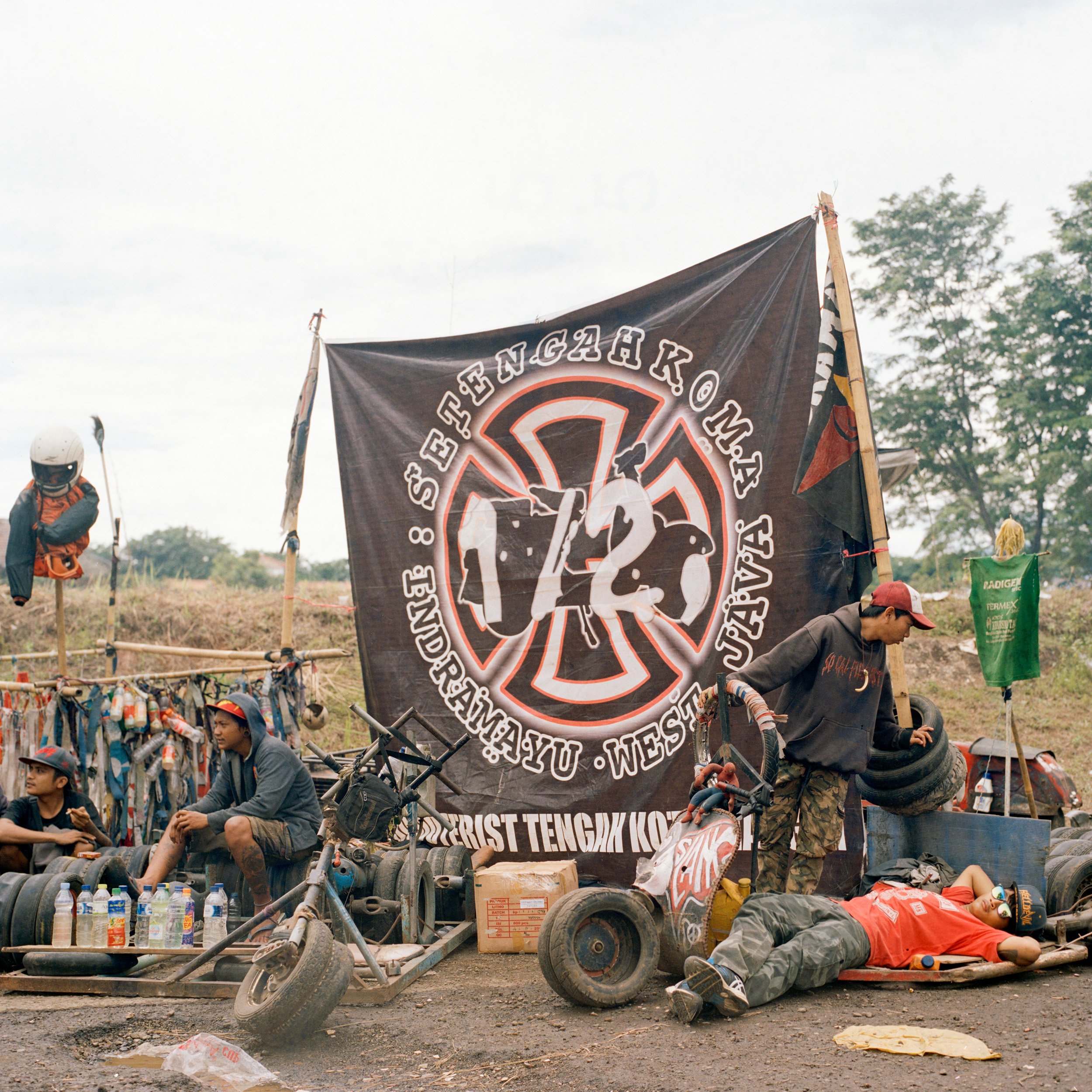
Although most adore classic Vespas, some take their passion to the next level by transforming the originals into versions never imagined by Piaggio. As if emerging from the Mad Max movies, these scooterists roam the streets riding custom-built Vespas, which look weird not only to outsiders, but even to people within the larger Indonesian Vespa community.

People call these scooters “Vespa Sampah” (“Garbage Vespa”) or “Vespa Gembel” (“Vespa Drifter”). The owners of these Frankenstein bikes prefer to call them “Vespa Extreme”. For them, the Vespa is not just a bike, but a lifestyle. It is an extension of personality—an exaggerated form of self-expression.
There is only one mandatory ingredient required in the extreme Vespa recipe: the original Vespa engine, which most are from the late 80s or early 90s, as they are more powerful than the earlier versions. From there, the magic follows. Some of these bikes have more than twenty tires attached to cheap DIY steel frames. Some are built from metal drums, or even trees. Some are adorned with a buffalo skeleton, bamboo, plastic bottles, or anything the owners could scrape together along the road. It seems that the builders’ creativity has no limit and the classics are merely a starting point.


It is difficult to determine the early history of these heavily modified Vespas. Their emergence by the early 2000s coincides with major changes in Indonesia, following the fall of Soeharto’s authoritarian regime in 1998. After the government reformed, Indonesians enjoyed more freedom of self-expression than ever before. This has contributed to the development of various types of modified vehicle on the road; not only Vespas, but also motorbikes and cars.
On the surface, many people may mistakenly think these Vespas are designed purely for show. In fact, they can actually be ridden, even if they are not really roadworthy. Riding them for thousands of kilometers is very common, and making long trips is the ultimate rite of passage for every Vespa enthusiast.


The Vespa has long been associated with a romantic vision of youth and of the outsider. While far from the aesthetic of the 1960s Mods that to this day is most closely associated with the Vespa in its original form, the same spirit of freedom persists. To go “on the road” is a very human yearning. We are drawn to move, to journey and migrate, to step into the unknown and search for meaning “out there.”
One scooterist, Delvis, speaks to this as he says:
Initially, I questioned what can I be proud of in Indonesia? At that time, it was the [2014] presidential election,” […] “Everywhere, everything was messed up. I was searching for the diversity and the culture of hospitality that Indonesians have.”
Source: National Geographic
Indonesia, a huge and diverse country, gives way to this adventurous lifestyle through lightly enforced rules of the road, though there is a real risk that if caught by police, vehicles can be confiscated. It is no wonder, then, that many Vespa nomads travel under the cover of night. In the dark, their engines sputter on open, traffic-free roads and unregistered, modified creations can typically go undetected.


The backbone of the Vespa community in Indonesia is a network of local enthusiasts scattered all over the archipelago. Gatherings are typically organized through social media or messaging apps. Visiting long distance riders are treated as family members and warmly welcomed. As the Vespa enthusiast motto says: “one Vespa, one million friends.” Along with cigarettes and home-brewed cheap alcohol, stories from the road will be shared, ready to inspire others to take the same path.
These days, it is unclear how many such Vespas exist in Indonesia. The community’s underground nature makes it difficult to know how many of them are on the road. They may number in the thousands. But, one thing is for sure, they can be spotted all over the Indonesian archipelago, even in its most remote areas.


This project was made possible through the support of the Goethe-Institut, Ostkreuz Agentur der Fotografen and Obscura Festival through the Southeast Asian Photographers’ Masterclass 2017. Rebel Riders is designed by Calin Kruse in collaboration with Yana Kruse and published by Dienacht.
Further Reading
See the wild, customized creations of Indonesia’s ‘rebel riders’ (National Geographic)
Interview: Rebel Riders – Muhammad Fadli (Asia Photo Review)
On the photographer’s site: muhammadfadli.com/rebel-riders
Muhammad Fadli is a Sumatran-born Indonesian documentary and portrait photographer based in Jakarta, Indonesia. His personal projects explore different themes such as the history of colonization, subculture, environment, and social issues. He splits his time between editorial assignments, corporate and commercial works, personal projects, and as a father of a young daughter.
He has published two books, Rebel Riders (Dienacht Publishing, Leipzig, Germany) and The Banda Journal (JordanJordan Editions, Jakarta, Indonesia). The latter, which was a collaborative effort with the writer Fatris MF, won Paris Photo-Aperture Foundation Photobook of the Year Awards 2021. His work has been published in National Geographic, Der Spiegel, Rest of World among others.