Text and photos by Tom White

In recent months there has been some excitement and much discussion around generative AI and especially ChatGPT. GPT stands for Generative Pre-trained Transformer and is a ‘large language model’ system trained on a massive amount of text data, using machine learning algorithms to generate human-like responses to text-based inputs.
For those of us who have been following technology news, or just watching and reading sci-fi, none of the debates around AI are particularly new – if you need to get up to speed, this episode of Bloomberg’s Big Take podcast is a great introduction – but it is interesting to have these tools increasingly at our fingertips.
So, in the spirit of play, I asked ChatGPT to generate “An introduction to Southeast Asian Photography” and this is what emerged.
Southeast Asian photography is a diverse and rapidly growing field that encompasses a wide range of styles, genres, and themes. The region’s rich cultural heritage, complex history, and vibrant contemporary life provide a wealth of inspiration for photographers.
Southeast Asia is a subregion of Asia that includes 11 countries: Brunei, Cambodia, Indonesia, Laos, Malaysia, Myanmar, the Philippines, Singapore, Thailand, Timor-Leste, and Vietnam. Each country has its own unique culture, traditions, and history, and these differences are reflected in their respective photographic traditions.
Historically, photography in Southeast Asia has been used primarily for documentary purposes, capturing important events and recording cultural practices. However, in recent years, Southeast Asian photographers have been exploring more personal and artistic approaches, pushing the boundaries of the medium and challenging traditional notions of what photography can be.
One of the most notable trends in Southeast Asian photography is the use of the medium to explore issues related to identity, history, and memory. Many photographers are interested in exploring the legacy of colonialism and the impact it has had on their countries and cultures. Others are exploring issues related to gender, sexuality, and social justice.
Southeast Asian photography also encompasses a wide range of genres, from documentary and photojournalism to fine art and fashion photography. Many photographers are exploring new techniques and approaches, including experimental and multimedia works that blur the boundaries between photography and other art forms.
Overall, Southeast Asian photography is a vibrant and dynamic field that is constantly evolving and pushing the boundaries of the medium. It offers a rich and diverse range of perspectives on the region’s culture, history, and contemporary life, and is well worth exploring for anyone interested in photography and Southeast Asia.
Interesting…
Compare this to a piece I wrote here.
Perhaps one of the clearest descriptions I read of this kind of AI is via Ted Chiang’s article for The New Yorker which puts forth among other things the idea that generative AI “paraphrases the internet”. Do read the article where Chiang discusses some of the ramifications of this. With AI chat looking set to augment or even replace internet search engines, this is an important topic.
As I say, much of these debates are not necessarily new, but they are finding their way into everyday conversation. If you are interested more broadly in the intersection of technology and photography, Fred Ritchin has been writing about this topic for around 40 years and I highly recommend his books. Here is a recent article of his for Vanity Fair on photography and generative AI.
I also admire the writing of artist Hito Steyerl, who is often concerned with how technology shapes society, and vice versa. She was recently interviewed for Artnet here. Steyerl’s book Duty Free Art: Art in the Age of Planetary Civil War is a good primer on her writing, full of outstanding essays.
Of course, here at Parallax we are very much concerned with photography and visual culture. Tools for AI image generation (or should that be AI image paraphrasing) such as Midjourney and Dall-E have potentially very significant implications. They are already divisive, being embraced by some and rejected by others.
The reality is that the technology is essentially neutral – even if the people behind it are not – it is how we use it that is the more important conversation.
One of the concerns often raised is the idea that artificially generated text and images could lead to incorrect, false and fake information. People have always lied to each other, misled each other, selectively used facts to pursue an ideology or an agenda, does technology make it easier for us to do so?
Perhaps with the answer to this likely being ‘yes’, it then falls to us to take responsibility and learn how to identify false information and to recognise when people are manipulating facts for their own ends.
Certainly, it is important to explore how such images are generated. In one interesting experiment, photographer Stephen Ferry posted images where he had “photographed different activities in Altos de Cazucá, a lower-income area to the south of Bogotá inhabited mainly by people displaced from the countryside by the war”. He then fed his captions of these images into an image generator and compared the results.
With an awareness of the fact that AI is being trained on data sets, the question must arise as to the nature of this data. We have been populating the internet for many years now, so what information have we provided these companies and their algorithms with? In relation to photography, we can perhaps guess at this by looking at the generated output following certain prompts.
With little expectation of being surprised, I entered the prompt “An award winning photograph of Southeast Asia” into Dall-E, which returned a set of mostly sepia toned, almost monochromatic, sunlight and mist filled images in which people were reduced to decorative silhouettes living romanticised, seemingly idyllic rural lives. Pictorial might be the kind descriptor here.

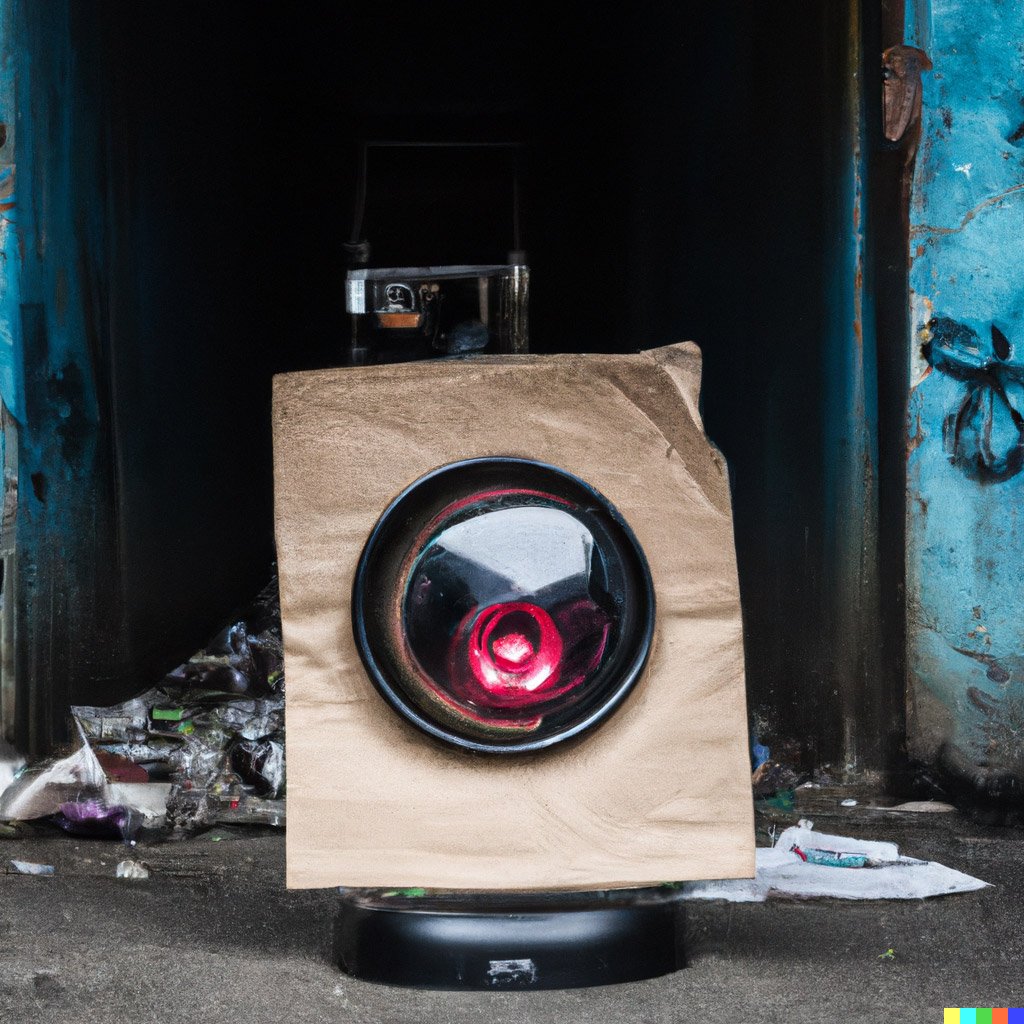
This reminded me of Max Pincker’s Trophy Camera – an AI powered camera, without a viewfinder or a screen “trained by all previous winning World Press Photos of the Year, from 1955 to today. Based on the identification of labeled patterns, the camera is programmed to recognize, make and save only winning photos.”
While some of this may seem relatively benign, even entertaining in an ironic fashion, it can easily become intensely problematic and extremely revealing, to the point where we seriously need to question the values we are perpetuating, and their manifestation in the data – and the cultures – we draw on. Much has been made of the tendency for these tools to “hallucinate”, something that Google’s forays into computer based neural networks were notorious for in the mid 2010s. What this tells us about the way we engage with the repository of social knowledge we are building online should give us much to discuss. Social media has already shown us what harm algorithmic digital content can bring, alongside its benefits, and how viral and uncontrollable these harms can become, yet our ability to learn from and regulate this is still playing catch up with the tools we are developing in this sphere.
If multi billion dollar corporations with numerous international offices cannot, or will not, take responsibility for what is published on their platforms, or through the use of their technology, can we users? If so, how? What do we need to do?
This is why at Parallax we have a code of ethics. As a society we need to be more open about our responsibilities and our failings, and we should be doing our best to address these issues in a constructive manner.
I have no doubt that a spectrum exists where AI image generation will on the one hand be employed in a short-sighted manner, with cost taking precedence over quality, generating and reinforcing stereotypes both benign and harmful, drawing on a narrow view of the world, and yet will also become a tool for unexpected creative expression with intelligence, wit and insight, broadening the scope of what is imaginable.
A case in point might be Aik Beng Chia’s generative art imaginings of Singapore’s Bugis Street in the 1970s, famous as a gathering point for the transgender community.
Chia writes:
Growing up in Singapore in the 1970s, one place that held a special fascination for me was Bugis Street (Bugis Junction). My late father used to take me there, and I remember being intrigued by the colorful characters that filled the street at night and day. The men in dresses and high heels, their faces painted with bold makeup, seemed like something out of a fairytale. Now, after 53 years, I find myself looking back on those memories with a sense of curiosity. What was it like to be there on Bugis Street in the 1970s, surrounded by transvestites and transsexuals? What was it like for them, living in a society that didn’t always accept them?
The results are highly stylised, in many cases revealing themselves to be illustrative, yet also wonderfully evocative. Note that they are clearly captioned as fictitious and “Made with Mid Journey”.
The results are highly stylised, in many cases revealing themselves to be illustrative, yet also wonderfully evocative. Note that they are clearly captioned as fictitious and “Made with Mid Journey”.

Compare Aik Beng Chia’s illustrations – which is perhaps a useful term to employ here – to the documentary photography of Bugis Street in the early 1980s by Alain Soldeville.
Is one better than the other? More accurate? More honest? For me, I feel they both have value. One is a document of the time, the place and the people in a way that we recognise as being a photographic record. The documentary “yes, this is what things looked like” ethos.
The other shows me a heightened “remembering” of the same, which puts me in the position of an observer, overawed by the spectacle of such a vivid experience. We all have memories that seem more than real to us, especially when we recall events from our formative years, and artists have always explored these themes. Isn’t the intertwining of memory and consciousness also a central theme of AI in sci-fi? Does it not bring to mind the implanted memories in the replicants of Philip K. Dick’s Do Androids Dream of Electric Sheep, brought to cinematic life in the cyberpunk noir of the Blade Runner films?
We need the real and the imagined. To have both Alain Soldeville’s photography and Aik Beng Chia’s illustrations of Bugis Street enriches, rather than impoverishes us.
Speaking of enrichment… We should also address who benefits from this technology financially. While the question of what happens with the wages and time of people whose work automation can make redundant is outside the scope of this short piece, it should concern us all. After all, it is often our data that tech companies are scraping, and our creativity and critical capacities that may be sacrificed in pursuit of lowering costs. While I welcome the moves Adobe is making to allow creatives to apply a “do not train” credential to assets, this is a very small step in the journey toward equity.
I am sure we will discuss further some of the implications of this here another time, as it raises many questions. For now, I encourage you to take a look into this technology and how it is being used, even if you have no intention of using it yourself.
Maybe Chat GPT is not so far off when it states that:
One of the most notable trends in Southeast Asian photography is the use of the medium to explore issues related to identity, history, and memory. Many photographers are interested in exploring the legacy of colonialism and the impact it has had on their countries and cultures. Others are exploring issues related to gender, sexuality, and social justice.
Southeast Asian photography also encompasses a wide range of genres, from documentary and photojournalism to fine art and fashion photography. Many photographers are exploring new techniques and approaches, including experimental and multimedia works that blur the boundaries between photography and other art forms.
Tom White has spent the last twenty years working in the fields of art, media and academia. He is a visual communications educator, as well as a photographer in the journalism, editorial, advocacy and commercial spaces. He designed and delivered the Photojournalism & Documentary curriculum for Yale-NUS College in Singapore, and has also taught at the International Center of Photography and Columbia University in New York, in addition to instructing and facilitating various workshops and community-based social programs. Tom’s current research includes a focus on the potential of immersive and interactive documentary methods, and the continued importance of visual and media literacy. He’s been based in Singapore since 2011.