By Tom White
I’m currently undertaking a Masters in planetary health, which is a relatively new field concerned with the intersection of human health and wellbeing, the health of the environment and the earth’s systems. It takes an equitable approach to political, economic, and social systems and how we can use these to address the triple planetary crisis of climate change, biodiversity loss, and pollution. As a photographer, my focus is on the importance of visualising and communicating planetary health stories, issues and concepts, so the work of Geela Garcia (Philippines), Aziziah Diah Aprilya (Indonesia) and Gab Mejia (Philippines) on show in the 7th Objectifs Documentary Award exhibitions were of great interest to me, beyond their obvious appeal as fine examples of photographic documentary. These projects all foreground an endogenous connection to place and environment through labour, community and spirituality, which are crucial aspects of the planetary health framework and must be included if we are to chart a course through to a more harmonious future with the world around us.
Geela Garcia: Tubig Alat (Salt Water)
Operating on the neighbouring islands of Guimaras and Iloilo in the Philippines, the two families of Emma Ganila and Lorlie Noblezada produce Tultul and Budbud – traditional salts – using distinctly different methods. In one photograph, a woman stands defiant on the shore, waves rippling around her ankles, feet emerge form a blanket, covered in a blackened sand, like the charred driftwood in a fire. Saltwater falls like diamonds and hands hold out salt in the form of tangled crystals and neat blocks. Bodies lift, stir, pour and cut, and stand proud, quiet as an ocean without storms. Through such images Geela Garcia reveals the processes of traditional salt making in the Philippines in Tubig Alat (Salt Water).

Garcia’s photography vividly evokes the textures of a saltwater environment. I can feel the smoothed driftwood, the sand between my toes, taste the smoke and salt in the air. The care that goes into something as everyday as salt emphasises the significance of these practices and the matriarchs’ dedication to preserving their heritage, underscoring the vital link between community, tradition, and the environment.
It’s extraordinary that despite the Philippines’ extensive coastline, it imports almost all of its salt. Local salt production has declined largely due to unsupportive economic policies and the non-industrial nature of small-scale saltmaking across the archipelago. Budbud salt is made through filtration with sand and evaporation in halved bamboo poles, while Tultul is filtered with ash and cooked with coconut milk.

That such diverse saltmaking techniques exist side by side, is plenty of reason to champion these alternative methods and challenge the one-size-fits-all approach that dominates our food system today.
Garcia takes a relatively simple premise and builds out an eloquent documentation of the two families’ work, going beyond mere process, to take us into the their lives. With half of the exhibit busy with the craft, and the other a more contemplative quiet, we get both a sense of activity and toil along with a necessary patience and peace.
Aziziah Diah Aprilya: Mattude

Aziziah Diah Aprilya’s Mattude similarly depicts a coastal community, this time in Makassar, South Sulawesi, whose livelihood is being threatened by a land reclamation project. Mattude is a local term which means “collecting the clams”, but this is not a narrative about aquaculture. The exhibition text describes indigenous coastal beliefs: of ancestors residing in the water, of offerings made to these ancestors, of a matriarchal ritual to prevent bad luck and disaster and to honour and give gratitude. It also tells us that since 2017 the coastal women of Makassar have gathered to organise protests against the development of The Makassar City Spatial Plan that puts their way of life at risk. The progress of the reclamation is displayed through satellite images displayed over an image of a mural showing children playing in boats — a literal obscuring of a potential future.

This is a common story the world over: People having their lives altered and changed by forces that seem to exclude their voice. Decisions made without consultation or care for the deeply held beliefs and connections that go beyond the provision of subsistence living. Such stories highlight the broader implications of policies on social structures and the politics of belonging.
This sense of belonging is evident in the scenes Aprilya shows us of women and children at work: collecting clams, at home, and at play. A ritualistic repetition broken by moments of spontaneity, such as a child standing in the surf on a piece of Styrofoam or a woman paused, staring across at an industrial horizon. It is also conveyed through the stories that Aprilya has collected and can be found in the form of postcards accompanying the exhibition. In one, an unnamed narrator describes a ritual offering to a grand aunt:
“If rituals are a way to remember, a way to connect with the invisible world, what happens if they slowly disappear? What if they no longer have a place in our lives?”

One photograph shows a boat in a state of disrepair, being absorbed by the surrounding vegetation, as if reminding us that our human inventions are transitory, that the elements cannot be so easily tamed.
Gab Mejia: The Forest Listens, Their Spirits Cry

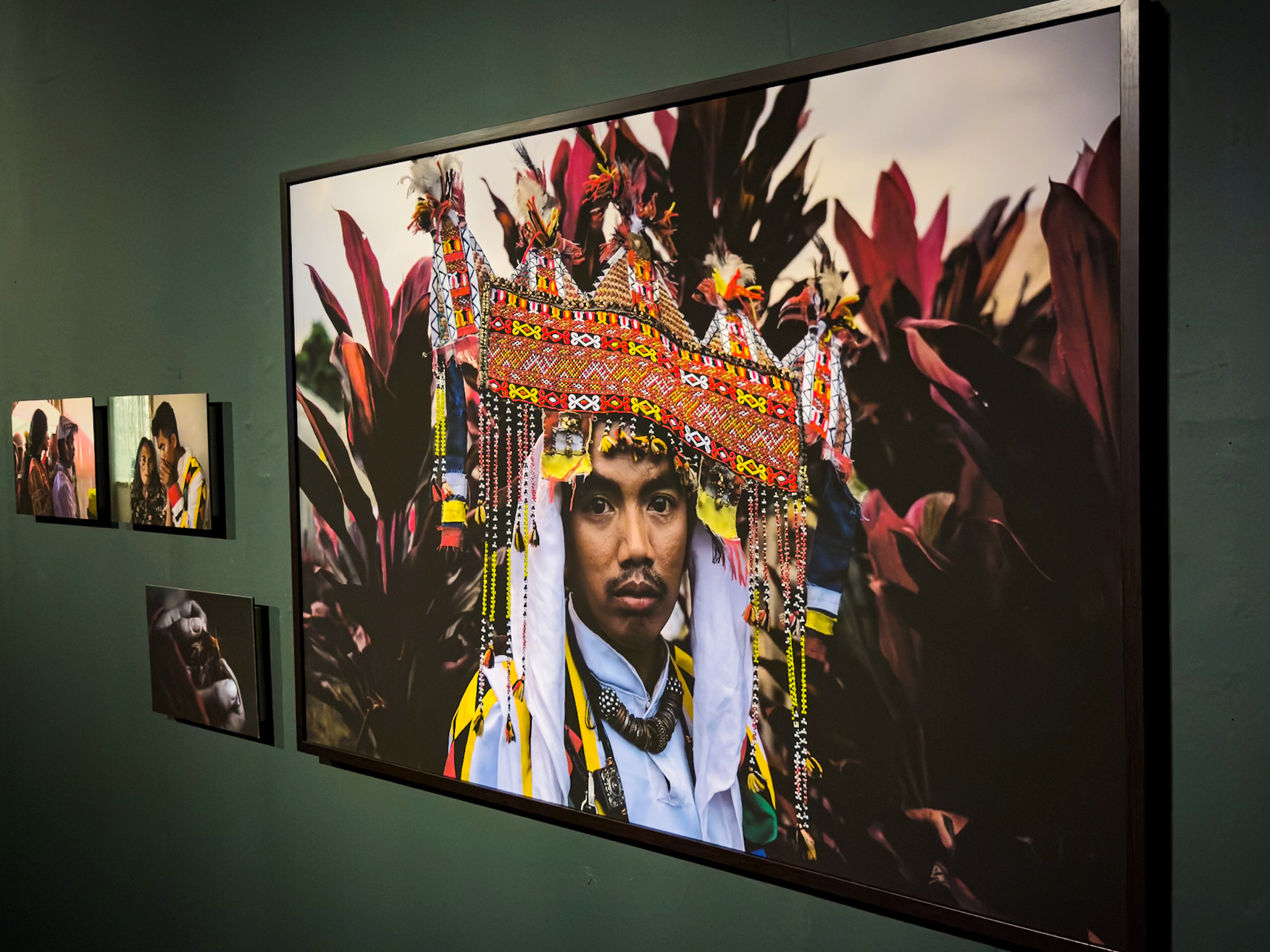
There’s an elemental crackle that greets you as you enter the Chapel Gallery at Objectifs, sparks from a fire mimic and dance with the branches of a tree in the opening image of Gab Mejia’s exhibition, The Forest Listens, Their Spirits Cry. Printed textiles hang from the ceiling, the low sound of wind through long grass emanates from a video projection, providing an extra dimension of presence to the photographs displayed on the walls, which are painted a deep green.
This series centers on the layered relationships of Mejia himself with Datu Arayan, a spiritual leader, and Krystahl Guina, a trans youth leader, both Baylans – shamans – of the Talaandig-Manobo people, and guardians of the sacred forests of Mount Kaluntungan in Bukidnon province in the southern Philippines. Unfolding over two years, the story is a narrative of identity, spirituality, tradition and ecology.
The photographs themselves reveal a range of approaches; from the documentary and journalistic, through the collaborative and performative. Connections between artistic expression (Datu and Krystahl are part of a performing arts group) and spiritual ritual are made, boundaries are blurred in the narrative approach, and we the audience are both observing and observed. These images gaze back. They depict the dissolution of boundaries between the human, the land, and the spiritual realms. Even genders are not distinct, emphasising the fluidity of identity and the idea that life is the many within the one.

The Forest Listens, Their Spirits Cry also positions itself as a counterpoint to a National Geographic article published in November 1913 entitled “The Non-Christian Peoples of the Philippine Islands”, an anthropological exploration of different tribes in the Philippines by Dean C. Worcester, who was Secretary of the Interior from 1901 to 1913, when the Philippines was under the colonial rule of the United States.
Pages from this publication are presented on one wall, angled into the space as if an appendix to the exhibit. While the original publication contains many pages of hand-coloured photographs which render the people’s depicted in a lurid garishness, alongside many other black and white images, Mejia and curator Goh Sze Ying have elected to omit the majority of these and print the text on translucent paper, removing some of its authoritative weight and rendering the text less legible. Alongside the richness of Mejia’s photographs, this century-old text is displayed as a point of view, repositioning it from a decolonial standpoint. I have written before that to decolonise should not be to erase, but to reassess, and this allows for just that.

Such an approach is also evident within the photographs. I was struck by the recurring motif of the butterfly (or moth) throughout. In the accompanying catalogue Krystahl describes herself as
a butterfly—
ugly, as time passes,
flies free.
a cat—cursed with elegance
We see butterflies and moths held tenderly, resting on human hands and also pinned in place within a display cabinet. Appearing as a prominent part of one image it is a forceful reminder of two distinct approaches to nature: one harmonious, reciprocal and holistic, the other domineering, cataloguing, classifying. Indigenous and colonial. The contradiction inherent in capturing and killing in order to preserve and display reveals that disconnection between the human and the more-than-human worlds which has come to characterise many of the problems that we now face in our triple planetary crisis: climate change, pollution and biodiversity loss. While I personally don’t believe that going forward, all of the solutions can be found by rejecting the modern and returning to some pre-industrial idyll, I certainly agree that we need to re-centre local, indigenous and traditional forms of knowledge in our approach to these crises.
The Forest Listens, Their Spirits Cry, Mattude and Tubig Alat (Salt Water) are collectively a beautiful and timely reminder that deep, meaningful connection is at the heart of understanding. To live a connected life is to live within the richness of the physical and spiritual worlds, and to live with love and care. Through their photography, Gab Mejia, Geela Garcia, and Aziziah Diah Aprilya illuminate the bonds between people, their environments, and their spiritual and ritual practices. As we rush headlong into an unknown future with all its technological promise and danger, we would do well to remember these deep connections within which we have evolved, and to place them at the core of our decisions and being, where they belong.

This exhibition was held at the Objectifs Centre for Photography and film from April 4 to May 18, 2025.
The photographers
Geela Garcia: geelagarcia.com
Aziziah Diah Aprilya: aziziahprilya.com
Gab Mejia: gabmejia.com
Aziziah and Geela were mentored by Jessica Lim and Gab Mejia’s exhibition was curated by Goh Sze Ying.
The Objectifs Documentary Award
The Objectifs Documentary Award champions Objectifs’ mission to broaden perspectives through image making, by supporting original voices in visual storytelling in Singapore and the wider region. The Award enables photographers to work on new or existing projects, encouraging them to tell stories about their native communities. It welcomes different creative approaches to non-fiction storytelling, from conventional documentary photography to visual experiments.
Truth Seeker Foundation
Truth Seeker Foundation believes that education and enlightenment are the best ways to address many of the social issues we face today. Amongst the many causes the Foundation supports, it advocates for raising awareness of social and environmental issues through photography.