Photos and text by Moon Rohaizan
There’s a saying: “Penyakit datang macam ribut. Pergi macam semut.” Illness strikes like a storm, but recovery is slow, like an ant’s crawl.
In the beginning, I was scared. I didn’t feel safe or supported by people I considered friends.
I had a shadow in my head, walking around with feelings of loneliness and emptiness. My shoulders were heavy with a weight I could not name. Some days I hate being myself, days that I want to disappear forever. Just get away from the life I once lived.
Comparing myself to others became routine. I was impatient, uneasy, and restless. I developed a narrative of my self-worth, or lack thereof. I hid my pain. I was afraid to ask for help. Scared to be vulnerable.
But I kept going.
It was a lonely journey.
Many employers in Malaysia don’t prioritise a positive working environment, and this leads to a culture where survival becomes the focus. Gaslighting, racism, exclusion, abandonment, and bullying are some of the many factors that contribute to a toxic workplace. In these environments, those who excel at playing office politics often get ahead.
The rest of us are left behind. “Be grateful for your job” has held us hostage for a very long time. We shrug and say “this is just how it is,” accepting a broken system instead of trying to change it. It can be incredibly isolating, taking a heavy toll over time.
Loneliness has broad physiological effects, from harming our ability to think, our self-control, our ability to relate to others, and damaging our immune system. Worst of all, it creates a cycle of behaviours that deepens that very loneliness across the breadth of our lives.
Mental health is still a taboo topic in many Asian cultures. Even in the professional space it is a largely unaddressed issue in Malaysia. When work denotes one’s value, identity, and worth in society to such a large degree, having a broken relationship with work casts a huge shadow over the other aspects of life.
For myself, I felt like I had become a burden to those I loved — I was the daughter / sister / friend / collaborator / colleague who couldn’t hold down a stable job.
I was looking for an escape, a safe space; this is my “why.”
Kim Young Ha, once said, “We believe that we learn about ourselves through other people. I think we can discover ourselves through others, like mirrors.”
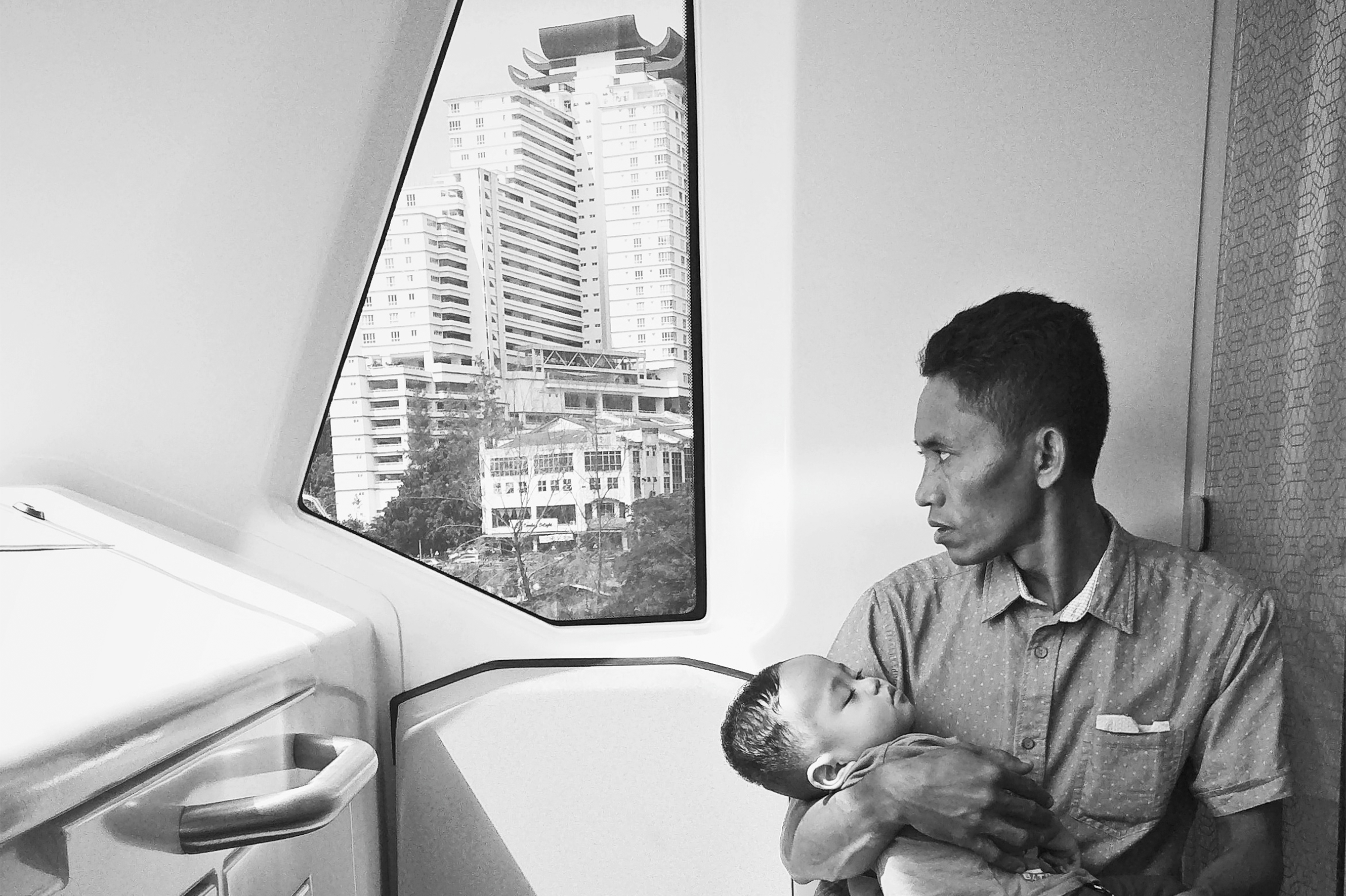
My daily commute took 40 minutes on Kuala Lumpur’s metro rail line (MRT). I noticed that people seemed disconnected, or not mentally present. This intrigued me. I created pseudo-narratives that everyone was hiding in their own safe spaces, heading towards a destination in their dreams. I began to choose the same seat when it was possible. I started photographing those sitting across from me; the repetition in the framing mirroring the repetition of the journey. I watched the morning light shift as the train moved from station to station. I watched the crowd move through the space.
My own melancholy was reflected back at me.
The commute was my refuge to dream of something better. Somewhere I belonged, somewhere I was appreciated. I found comfort in imagining that my fellow commuters shared the same dreams; of the promise that hard work will be rewarded with security, stability and a sense of belonging. As dissociated as we were from each other — and perhaps ourselves — in making their portraits I searched for some connection, something positive in the loop of the rat race, in the repetition of our 40 minute commute.
I believe change is possible. It’s time we start rethinking how we work and create environments where everyone has a fair chance to succeed.
40 minutes is exhibited in Germany at Mitsuko Castle in April 2025, and at NordArt in June 2025.


N. Munirah (Moon) Rohaizan is a self-taught photographer and seasoned project manager based in Kuala Lumpur, Malaysia. She discovered her passion for photography while studying business in Dublin, Ireland, a pivotal moment that shaped her creative journey.
Currently, she manages the Kuala Lumpur Photo Awards (KLPA), one of Asia’s leading photography competitions. Her curatorial contributions include assisting with the MOCA Fest visual art team at the World Islamic Economy Forum (2015) and managing Exposure+ Photo Festival (2022, 2023). Moon has also collaborated with cultural organisations such as the Two Mountains Photo Project 3.0 and PhotoSymposium Asia.
Internationally recognised for her expertise, she spoke at the Suwon Photo Festival (2022) and co-curated the 4th Jeju Biennale (2024). She was also part of the publication Kuala Lumpur-Berlin, Kisah Dua Bandaraya (2011). With a passion for storytelling, Moon’s work reflects her commitment to amplifying diverse narratives in Malaysia and beyond.