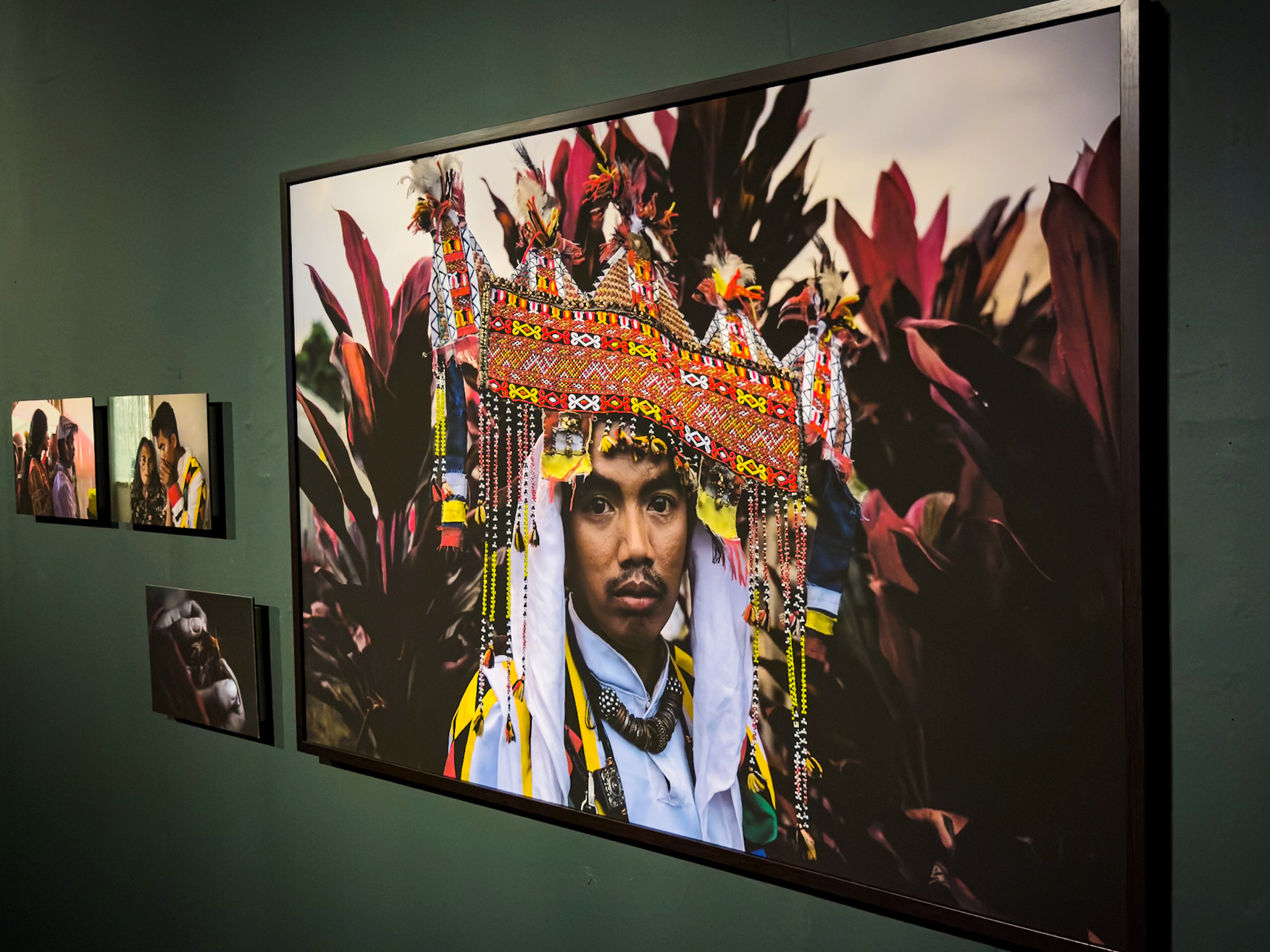
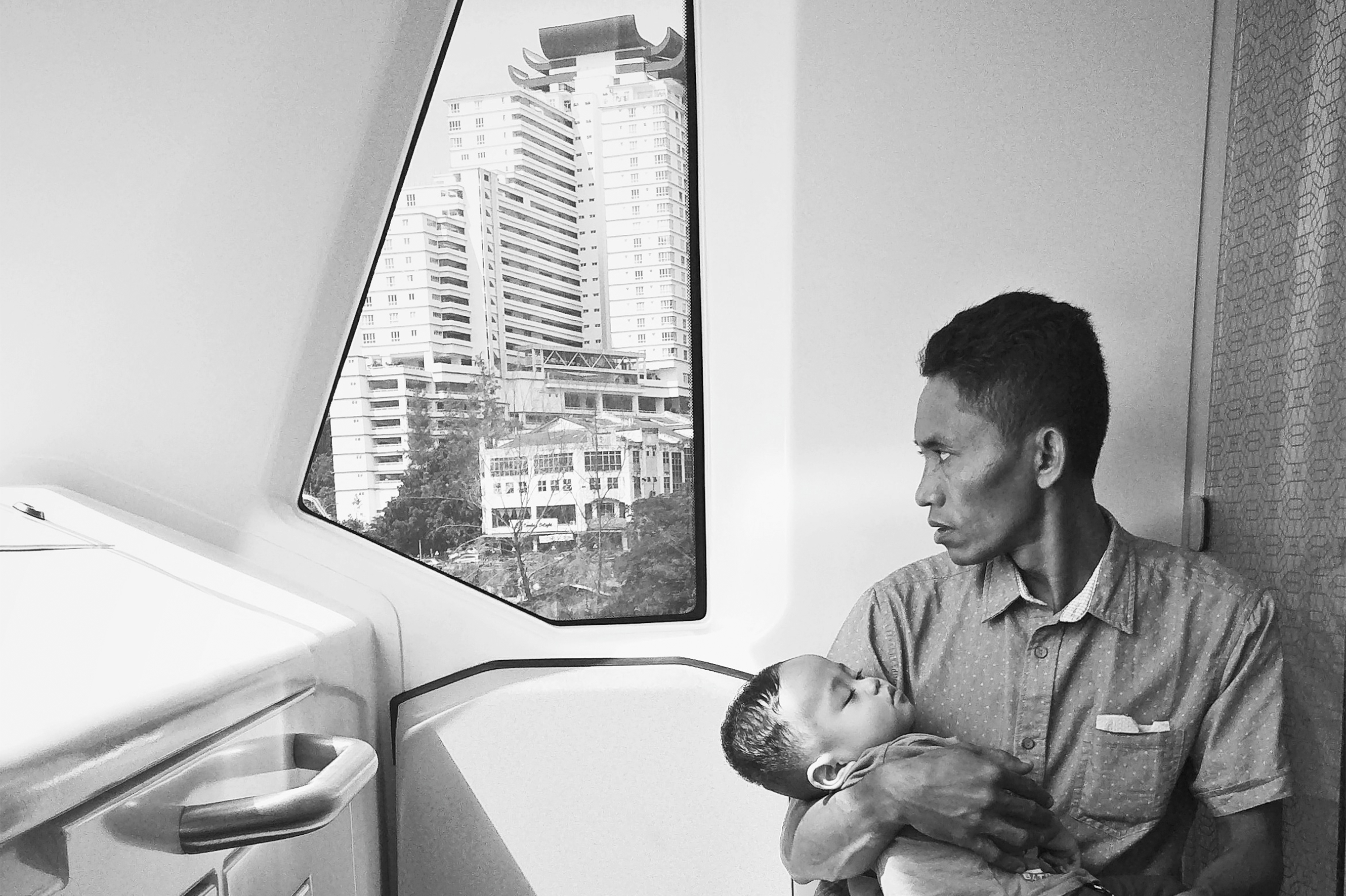
L-R: Tom White, Mark Cheong, Wallace Woon and Ore Huiying in conversation at Objectifs. Photo: Shian Bang
⬛ This is a recap of our conversation on Singapore photojournalism at Objectifs on 25 June.
Recently, our Editor-in-Chief Tom White moderated an evening with photojournalists Wallace Woon, Mark Cheong and Ore Huiying at Objectifs in Singapore. The three photographers brought their extensive professional experience to bear in this conversation, sharing candid reflections on the profession and the challenges of visual news in a saturated and shifting digital media landscape.
Breaking news and photo essays
In Singapore, where the news cycle often revolves around meticulously planned announcements and tightly managed events, everyday scenes often make headlines. “Some of these stories wouldn’t even register as news for an international outlet,” said Wallace. “When people think of photojournalists, they imagine someone in an exotic place with a scarf around their neck photographing dramatic events, but here, local events often constitute the bulk of our work.”
In many ways this focus on local news is true elsewhere, however, with Singapore being a city state, local news is often national news, and as such it can feel prosaic. In some ways, this hyperlocal coverage pushes a degree of creativity; how do you make a compelling image from a ‘a non-event’? As Mark noted “the first thing that draws you in, I feel is the picture, right? You read the headline, but it’s always the picture which kind of gets your attention.”
The discussion turned from the breaking news demands of fast, illustrative images to longform projects involving initiating stories, doing research, building contacts, and developing narratives over time. Here, the emphasis is on building trust with communities and making connections. Wallace’s story on the closure of the Saddle Club stables is an example of an opportunity to take a local news event, and build a story around it with an empathetic human angle. Mark drew on the example of a story on children’s nursing home, which required a year’s worth of relationship building before gaining permission to document life inside. This kind of work is what he currently thrives on, and he emphasised how important it is to remember that stories are everywhere, including in your own backyard.


Ore, who covers stories for Bloomberg, the New York Times, and other major western publications, offered a counterpoint to this with international coverage and how often its focus is broad themes. During the recent elections, her coverage for Bloomberg’s international audience revolved around the two most prominent candidates – Lawrence Wong and Pritam Singh – while Singapore’s media carried extensive coverage of many candidates. China’s geopolitical reach in the region is a staple, with photos from cultural events, like Lunar New Year celebrations, used to illustrate a New York Times story on China’s perceived influence in Singapore. This also arose in discussion of Ore’s work along the Mekong, which led to an assignment from the Washington Post on Chinese funded hydropower projects in Laos.
When news outlets do publish work from longform projects, it’s often a news angle that dictates the manner in which they are published. While this can feel reductive, it does generate opportunities to develop and fund other aspects of the story. Ore shared how grant-funded projects can allow NGO partners to use images to maximise the impact of the photographs.
Ethics and bias
The question of bias was brought up. How much control do photojournalists have over their photographs being used to represent someone in a particular way? Wallace and Mark both noted how the demands of the industry mean that the sensational image is frequently selected over others. “If you have a picture of Donald Trump with his hair flying around looking weird,” said Wallace. “You know that is the one that will get used in certain places. But you’re also going to file the more flattering image, and that’s the best you can do sometimes.”
This issue of media bias is complex. Often, as news photographers, you don’t necessarily have control over how images are used in the media. As much as possible, the responsibility of a journalist should be accurate, honest and objective reporting. However, it is important to also acknowledge personal bias, and that can be an approach, especially in pieces that lean towards editorial and documentary, rather than standard news reporting. If you are afraid that your photographs will be read or used in a way that you didn’t intend, then your only choice is not to put those photographs into that space, but that also means sometimes you can’t do your job. Hopefully you work with the writer and editor to discuss these things and make sure that what is published is as accurate and free of bias as possible, and that any personal perspective is duly acknowledged.
Living a full life makes you a better photographer
The conversation touched on the hidden emotional toll of the job. Immersing yourself in stories has its price. To do the job well, photojournalists live those stories while working on them, and the demands of the profession mean that you do this again and again, week in, week out. This can lead to an obsession with the news cycle, and an intensity over issues being covered, and the taking on of people’s concerns as you cover their stories. The glamourisation of journalists as high-strung adrenaline junkies is an unhelpful – if not always inaccurate – depiction.
It’s important – as in any profession – to take time away. You don’t have to live photography 24/7. Pursue other interests, leave the camera at home sometimes (hard for a breaking news photographer!) experience life as a person, not just as a photographer. In fact, everyone agreed you become a better photographer when your time is not so consumed by photography.
On Technology
Technology continues to change the landscape, shifting the ground beneath our feet. A quick audience poll revealed that few people still buy print newspapers, with most consuming news via free online platforms and social media. Outlets know this, and as such photographers are often asked to provide images that will work in that context. This has its share of problems, but also brings a wealth of opportunities. Multimedia reporting with audio and video is commonplace, though newsrooms don’t always resource these well, expecting reporters to provide text, photos, audio and video as required.
While the digital space provides an opportunity to consider the best way to produce a story, Ore warns, “you don’t want to do certain treatments for the sake of it. It’s really pinpointing what works for the project and how you are going to present it, for what audience, and then from there decide on the kind of treatment.”
Similarly Mark spoke about how he would like to see more complex visual storytelling in news media, noting that there’s the potential for doing more longform stories. Wallace added that there’s a process here in the creation of the news also, “a story doesn’t happen in five seconds. A story happens over a few years.” The context of any given story can be wide and can move beyond that one dramatic movement. Even with breaking news images, a citizen might record an event as it unfolds, but is not necessarily going to be the person who’s going to tell that in-depth story about the aftermath, the consequences, or the context of what’s happening. That’s where the skill set of a photojournalist comes in.

The AI question
Just as social media has changed the way most people consume news, AI is similarly disruptive. While everyone was concerned with the potential for AI to undermine the veracity of a news image, it doesn’t mean that photojournalism will be replaced by synthetic imagery; though a shift from photography to (photo-realistic) illustration is a possibility as newsrooms cut staff and budgets.
Aside from job security and the need for photographic documentation, it becomes a question of visual literacy. If we are allowing AI generated imagery to become commonplace and if our digital media space is being flooded with this, then what does that do to our ability to discern fact from fiction, or even to tell what constitutes a “good” photograph?
The role of news outlets is not necessarily to shape the way people look at images, but to maintain a standard. If AI-generated imagery is an aggregated average of the images that artificial intelligence models have been trained on, then the visual language that we are consuming is also averaged and aggregated. To a certain degree, the level of trust is already broken. We choose what and who to believe. When you are looking at a whole raft of different things or a whole raft of different sources – some of which may be AI generated – who has time on their commute to fact check and verify everything that they are scrolling through? And if you use an AI tool as your factchecker…? Misinformation abounds…
We wrapped up with the idea that a lowest common denominator news landscape is not where we want to be.
We want to be pushing the idea of storytelling, pushing the idea of visual literacy – in a variety of media – so that people can be informed, and their lives are enriched by what they see.
And critically, we can only do that if an audience is engaged. Given the turnout for this conversation, there is hope for the future yet!
Thank you to Objectifs for hosting this vital conversation, and thanks to everyone who joined us there!
About the photographers
Ore Huiying is a photographer from Singapore. She grew up in rural Singapore, but was uprooted to an urban environment as her country
developed. As a result, she is drawn to narratives of people and places affected by development.
In 2010, Ore moved to London to study an MA in Documentary Photography at LCC. After four years of studying and living in London, she returned to Singapore to focus her photographic practice on Southeast Asia. Apart from working on personal projects, Ore does commissioned work for international publications like the New York Times, the Washington Post, Bloomberg and Getty Images, as well as for various NGO and corporate clients. Her photographic works have been exhibited in photo festivals, museums, and galleries worldwide.
In 2018, Ore won the Invisible Photographer Award for her documentary project and was selected for the World Press Photo 6×6 Global Talent Program in the same year. In 2020, she was awarded a National Geographic Explorer Grant to continue her exploration of the environmental and social impacts of dam construction along the Mekong River.
Wallace Woon is a Visual Correspondent at CNA Digital. He previously worked at The Straits Times and the European PressPhoto Agency. He has covered summits and tournaments as well as stories on people and communities. He enjoys making food and staring at the sea on his days off.
wallacewoon.com | @wallessgram
Mark Cheong has been a photojournalist with The Straits Times since 2012 and has covered everything from football to festivals, and robberies to riots. He enjoys working on long-form feature stories and has been on assignment extensively in the South-east Asian region, in which he has a keen interest. Off work, he likes skateboarding and making zines.
Tom White is Parallax’s Editor-in-Chief. He is originally from Yorkshire in the UK and is currently based in Singapore. He is an avid enjoyer of the outdoors, and has spent the last twenty-five years working in the fields of journalism, art, media and academia. He is a visual communications educator, as well as a photographer, editor and writer, and occasionally works on curatorial projects.
Tom is currently undertaking a Masters program in Planetary Health. His research includes a focus on the potential of immersive and interactive documentary methods for community led advocacy on social and environmental issues, and the continued importance of visual and media literacy.