Text and photos by Tom White

I visited Banda for the first time when the west wind was blowing in full force… I could only travel between Naira and the three small islands that were close by, witnessing how thousands of lives were still dependent on spice-producing trees. I saw how the Bandanese lived side-by-side with old forts covered in moss, cannons, and other vestiges from centuries past that seemed trapped in a strange dimension.
Fatris MF, The Banda Journal, p.10
Let us begin somewhere near the middle of the story, with a seemingly innocuous photograph. The unfurling fronds of a palm foreground the image, partly obscuring this view from Banda Besar Island across to Hatta Island, the easternmost of the tiny and remote Banda Island chain which forms part of modern day Indonesia. Tropical blue sky, scattered clouds, specular sunlight on the ocean, waves hinting at a breeze all convey a sense of banal tranquillity. Yet, the place depicted here holds a history that is anything but tranquil.

The Banda Journal’s authors, Muhammad Fadli and Fatris MF set themselves the unenviable task of navigating the reader through the dense and complex history of the Banda Islands, while keeping us firmly grounded in the lives and stories of the people of Banda today. That they are able to do this in a way that is engaging, informative and richly rewarding of the attention a reader brings to the book, is what makes The Banda Journal such a compelling publication.
The text of the book is written with a lightness of language that belies the depth of research and the breadth of the subject matter. Layering the stories of present day islanders with a traversing of history, Fatris MF manages to inform and entertain in equal measure. Muhammad Fadli’s photography could easily find itself relegated to the role of illustration, yet it avoids this both through the publication’s design, which integrates the two so that the photography intersects the text, and through the images themselves which contain a subtlety such that once the reader has finished the book, the compulsion is to reopen it and look back through the images, discovering details that impressed themselves yet only become significant once one has learned of the context in which they appear. It is worth noting that the text of the book is both in Indonesian and English, with a rough matte paper stock akin to newsprint that puts it at a remove from the “coffee table” styling of many photo books. In fact, The Banda Journal could barely be said to be a photo book at all, given the unified nature of the text and images.
It is, however, difficult to understand the importance of the Banda Islands, and as such The Banda Journal itself, without understanding something of the islands’ history, the history of the spice trade—specifically nutmeg—and the rise of European colonialism and corporate capitalism.
While this is explored throughout The Banda Journal, allow me to attempt a concise digression into this history to provide some context.

The Banda Islands exist within a complex network of trade stretching throughout Southeast Asia and west to the Indian Ocean and beyond. This Maritime Road of jade, silk and spice had been plied by merchants of Arabia, India, the Chinese dynasties, and the Srivijaya and Majapahit empires long before Europeans arrived in search of the valuable spices traded in their markets.
This trade played a key role in the European colonial subjugation of people and place that reshaped the global networks of wealth and power, and created a legacy that persists to this day.
In his sweeping book on the subject, The Nutmeg’s Curse, Amitav Ghosh notes that:
In the late Middle Ages, nutmegs became so valuable in Europe that a handful could buy a house or a ship. So astronomical was the cost of spices in this era that it is impossible to account for their value in terms of utility alone. They were, in effect, fetishes, primordial forms of the commodity; they were valued because they had become envy-inducing symbols of luxury and wealth, conforming perfectly to Adam Smith’s insight that wealth is something that is “desired, not for the material satisfactions that it brings but because it is desired by others.
While trade between Europe and Asia had existed for millenia, by the medieval European period, merchants from the Maritime Republics—primarily Venice—largely controlled the European spice trade. In the late 15th century, King John II of Portugal became determined to break the dominance of these Republics and also of the Arabian merchants, who controlled access to the Indian Ocean via the Red Sea, and the overland routes to Asia. This led to Portuguese expeditions eastwards, rounding the southern tip of Africa at the turn of the 16th century. The Portuguese first seized Goa from the fragmenting Bahmani Sultanate, and from there, conquered the entrepôt city of Malacca. It was here that the Portuguese are said to have learned that nutmeg originated solely from the Banda Islands. With Malay pilots guiding them, they set sail, and were the first Europeans to establish a direct trade route with the “Spice Islands.”

By the middle of the 16th century, the Portuguese and Spanish—along with the English, French and Dutch—entered a period of conquest and genocide which would last for centuries. Millions of indigenous people across the world were killed by war and disease. Millions more were enslaved, most notably Africans, who were transported to the American continents. Many did not survive the journey, or subsequent treatment at the hands of slave owners.
In the Eurocentric telling of history, this period of time is referred to benignly as the “Age of Discovery” or the “Age of Exploration”. This is disingenuous at best. The real driving force was the pursuit of wealth, and a desire to monopolise trade via the control of resource extraction. This became inextricably linked to sanctioned violence and conquest. A philosophy of superiority of race, class and religion emerged, and was used to justify brutal suppression and occupation.
From this geopolitical reconfiguration arose the first modern corporations: the English East India Company (EIC) founded in 1600, swiftly followed by the Vereenigde Oostindische Compagnie (VOC), or the Dutch East India Company, in 1602.
The origins of the EIC and VOC are well documented. They essentially consisted of cartels of privateers, whose trade and plunder was legitimised by the state. The modern economic structure of intertwined private enterprise and state power had begun on a global scale.

In 1606, as the Dutch were beginning to expand their influence on maritime space, a man named Jan Pieterszoon Coen joined the VOC. Coen would become infamous thanks to the level of violence he used to secure a Dutch monopoly on the trade in nutmeg, mace and clove. In 1609 he was part of a Dutch expedition that fought with the Bandanese, resulting in the deaths of three of Coen’s commanders and their guard, after the Bandanese refused to acquiesce to a Dutch monopoly and occupation. A reminder that the history of empire is also the history of resistance to empire. Coen’s subsequent petition to take complete control of the islands would lead to the most brutal example of his ruthlessness.

In 1621, now as Governor General of the VOC, Coen arrived in Banda with one aim; to subjugate its people once and for all. After some pretence at making an arrangement with the islanders, he rounded up a number of Orang Kaya—the representatives of the Banda Island population—and, using Japanese mercenaries, proceeded to murder them and engage in an all-out conquest of the main island of Banda Naira. It was an act of premeditated genocide. The Bandanese, who had wished to defend their own interests by trading with a number of different partners, and who had themselves at times resorted to violence in order to resist invasion, were all but exterminated. Those who were not slaughtered were subjugated, or fled.
Coen was chastised by some of his contemporaries, a testament to the extremism of his actions, even by the standards of the time. Despite this professed dismay, Coen’s conquest was ultimately rewarded. Over two centuries after his death, Coen was still held in such esteem by the Dutch that his statue would be erected in Batavia—modern day Jakarta—and another in his hometown of Hoorn. The Batavian statue would be removed in 1943, by the Japanese, another conquering imperial power.
There is no image of Coen in The Banda Journal, only descriptions of actions and artefacts. Writer Fatris MF refers to a painting depicting the massacre in the local museum on Banda Naira, and a portrait of Coen, a man with a “pointed nose, a blond moustache and a cold stare”. The museum keeper seems ambivalent, as unaffected by the horror as she is by Fatris’ presence. As Fatris observes, “In Banda, people have come and gone for Centuries.”
Yet this massacre of 1621 is far from forgotten. In a photograph of a ritual performed by the villagers of Selamon, bamboo is held aloft to signify the poles that the heads of the murdered Orang Kaya were impaled upon. The scene is photographed by Muhammad Fadli from a respectful distance, with the participants’ backs toward the viewer, placing us in the position that aligns us with their gaze. It is the ocean that is faced, again signifying its primacy in the story of these islands.

After the massacre, as the Dutch began to control the nutmeg plantations, a macabre irony then occurred. Lacking the knowledge to cultivate the plants that bore the valuable spices, the VOC had to find and enslave the Bandanese who had survived the genocide, putting their indigenous knowledge to work in the service of the company. This workforce was then expanded with indentured labour from across the Indonesian archipelago. This, along with intermarriage between colonial men and local women means that today the roots of the Banda Islands population are many.
One such islander is Pongky van den Broeke, whose name immediately points to his mixed ancestry, going back thirteen generations to Pieter van den Broecke, a merchant of the Dutch East India Company appointed as Jan Coen’s successor. A reproduction of his ancestor’s portrait hangs in Pongky’s home.

Fadli photographs Pongky on the prow of a small boat, surrounded by water and framed by coastline. He is still, as if lost in contemplation of the eddies and currents. His business is nutmeg production and processing, a rarity for the islands, which are still engaged largely in the export of the raw material. Pongky reflects on what he calls the “tree that caused a lot of disputes” with the words “Now, a kilo of nutmeg can only buy enough to eat for one day.” Nutmeg is still Banda’s top commodity, though this once lucrative business has lost much of its prior value.

While infused with history, The Banda Journal is a book about the present, and contains many portraits of those living on the islands today. These are often presented in a semi-formal manner, reminiscent of the typological portraiture of the earliest days of photography, where people posed in the landscape they inhabited, unmoving in front of the documenting lens. While largely due to the technical considerations of photography at the time, this formality is also part of the colonial project of recording and categorising. Given that these portraits are a record of a people that—while marked by the history of forced migration, displacement and genocide—are living and present, and that the photographer shares their nationality and heritage, could it be too much of a stretch to say that here Fadli is creating images that subvert that colonial gaze?


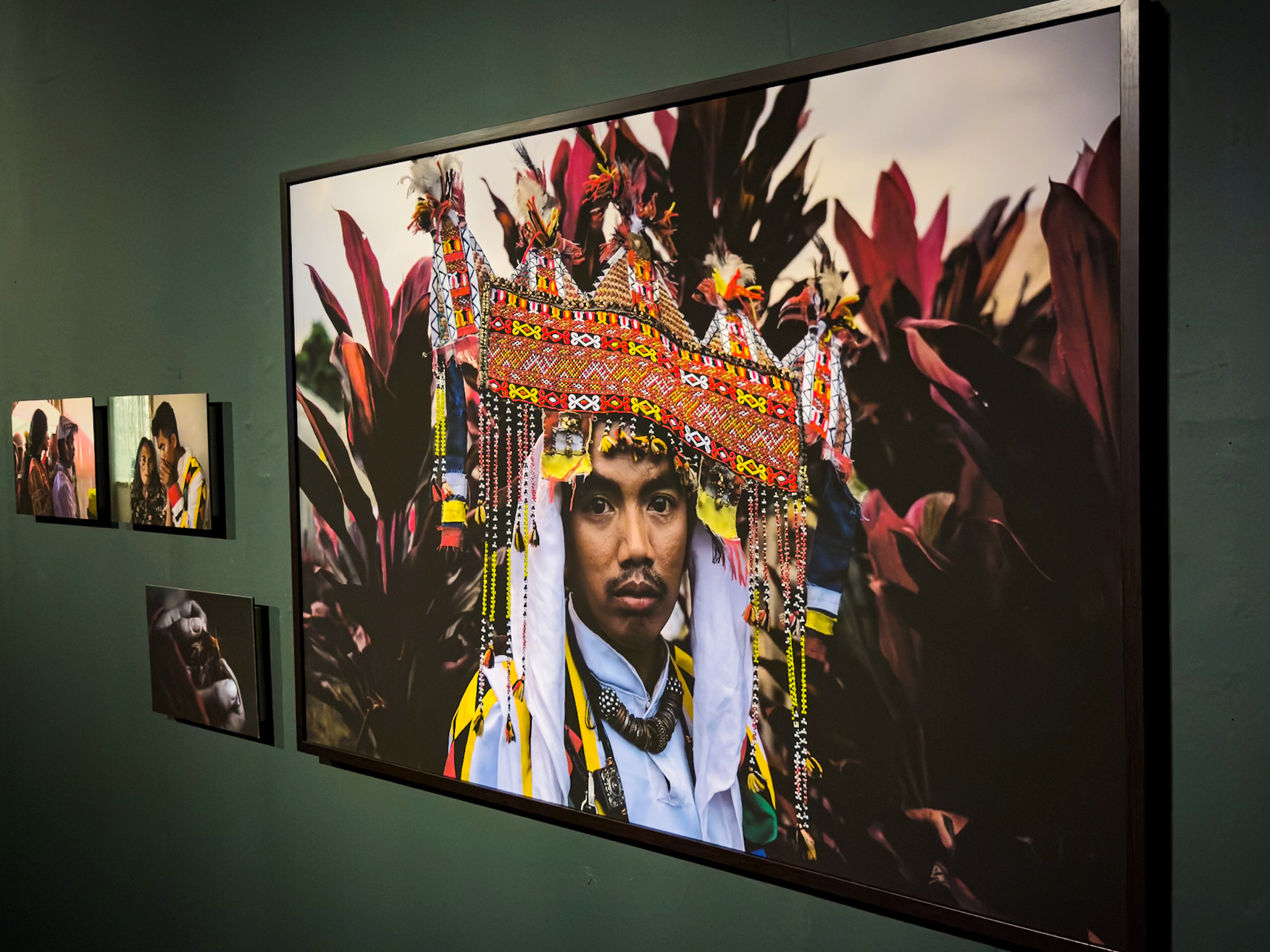
This subversion is on display with an odd kind of morbid humour in the portrait of a Cakalele performer – a traditional war dance from Maluku – whose traditional outfit is adorned with a Portuguese army helmet, as if an appropriated trophy. The performer’s mouth is curled into a slight smile while the eyes contain a hint of stoicism. In the face of an erasing modernity that favours an international homogeneity, there is here an element of defiance.
These subtle subversions continue throughout, as if deep time makes a mockery of the idea of enduring empire against the measure of ages that the landscape exists in. Elemental forces have their own character here. In a photograph of a stormy grey sea, the wind peaked waves echo the volcanic outcroppings of rock, in turn shrouded in rain clouds. Here the elements converge with the feeling of foreboding that accompanies many a gathering storm. The caption tells us that this is the western monsoon season, the same season in which early traders and Europeans arrived in the Banda.
In other images we see farmers, fishers and those who work the land for their livelihoods. It would seem that after four hundred years of colonial history we have come full circle: to a subsistence economy with commodity exports that do little to enrich the finances of the islanders themselves, while multinational corporations who look to expand their profit margin do so with scant care for the individual producers.


But spice is not the only intersection of the Banda Islands with geopolitics. For a brief period, the island of Banda Neira was the home of Mohammad Hatta and Sutan Sjahrir, exiles imprisoned by the Dutch in 1934 for their anti-colonial activities. In an echo of the past, they were brought to Banda.
As Indonesia gained independence in the Post WWII era, Sjahrir and Hatta became Prime Minister and Vice President, respectively. Two of the islands now bear their names. The story of their exile is one of the most poignant chapters in The Banda Journal, with Fadli’s photography and Fatris MF’s writing echoing with the ghosts of past conversations and laughter, all now “curled up in silence.” Their time on Banda spent with local families and fellow exiles is remembered in fading memorials, and in the lives of today’s residents such as Ramon Alwi, the son of Des Alwi, who as a child played with “Uncle Rir.” He later became a diplomat and historian, creating the Banda Neira Culture and Heritage Foundation.
For a time, then, the Banda Islands played a role in the complex anti-colonial struggle of Southeast Asia, when possibilities of a different future propelled change.
It is in this chapter that we encounter the image of the unfurling palm, with the renamed island on the horizon, and the glittering ocean between. This serene image is full of the richness of time. A simple signifier of something much more complex.

That time emerges as one of the central themes of The Banda Journal should come as no surprise. One of the earliest images in the book is of Fort Concordia, built by the Dutch in 1732 on the site of an earlier fort from 1630, ostensibly to protect the local village of Wayer from pirates.
Here, a figure stands framed in an oval opening, hands clasped behind his back, facing out across that same stretch of sea and sky to Hatta Island. The harsh sunlight somehow diffuses throughout, with the fort’s wall forming a shadowed band across the image. The wall itself is in the shade of overgrown trees and shrubs, roots reaching to connect with a carpet of green across the fort’s interior. It is as if this is an image of opportunity, of the past and future, and the moment we inhabit between the two.

This quiet contemplation exists throughout the Banda Journal, despite its exploration of colonial violence, ongoing trauma of dispossession, and the inequity that is the inevitable outgrowth of settler colonialism, trade-as-conquest, and the desire to turn all land into a source of efficient economic productivity, regardless of the environmental damage this can cause.
This philosophy of subjugation and of the value of nature rooted primarily in the economic has become part of the capitalist orthodoxy: one that views the nonhuman world as a resource to be exploited. More symbiotic relationships are treated as unproductive, a further justification for the suppression of indigenous cultures that continues to this day.
Much has been written about the idea that indigenous communities could not conceive of the settler colonial idea of land “ownership,”, and as such were naively taken advantage of by conquering Europeans. Our recurring and increasing economic and environmental problems today would suggest that it is the systems of global imperial capitalism that are naive, and in their naivety, they are causing great harm. In Banda, the population was almost entirely exterminated in pursuit of a monopoly of wealth. While a handful of nutmeg will no longer purchase you a ship or a house, other commodities have taken its place. The desire to control trade has only intensified.

Could The Banda Journal be a parable warning about the attempts to hoard a concentration of wealth at the expense of all else? Could it be a lesson that in our attempts to terraform the planet for resource extraction, we will plant the seeds of our own destruction? What systems of oppression will emerge—or persist—and who will be left behind?
Documentary photography claims to seek the truth through the stories and perspectives it relates. As practitioners, we have a duty to contribute to this conversation and to ask, and maybe answer these questions.
In addressing Banda’s history, The Banda Journal is an example of a decolonial text in that it confronts the legacy of the past, and broadens our understanding. To decolonise should not mean to erase the telling of history from the position of the colonising powers, but to expand our understanding of this history by including the voices of those who have been ignored, or worse, silenced.
To decolonise is to recontextualise accounts, opinions and perspectives with a richer, more nuanced historiography and yes, to undo systems of hegemonic knowledge production. It is better to leave the lies, perspectives and propaganda in plain sight and continue the discussion around them, rather than remove and replace.
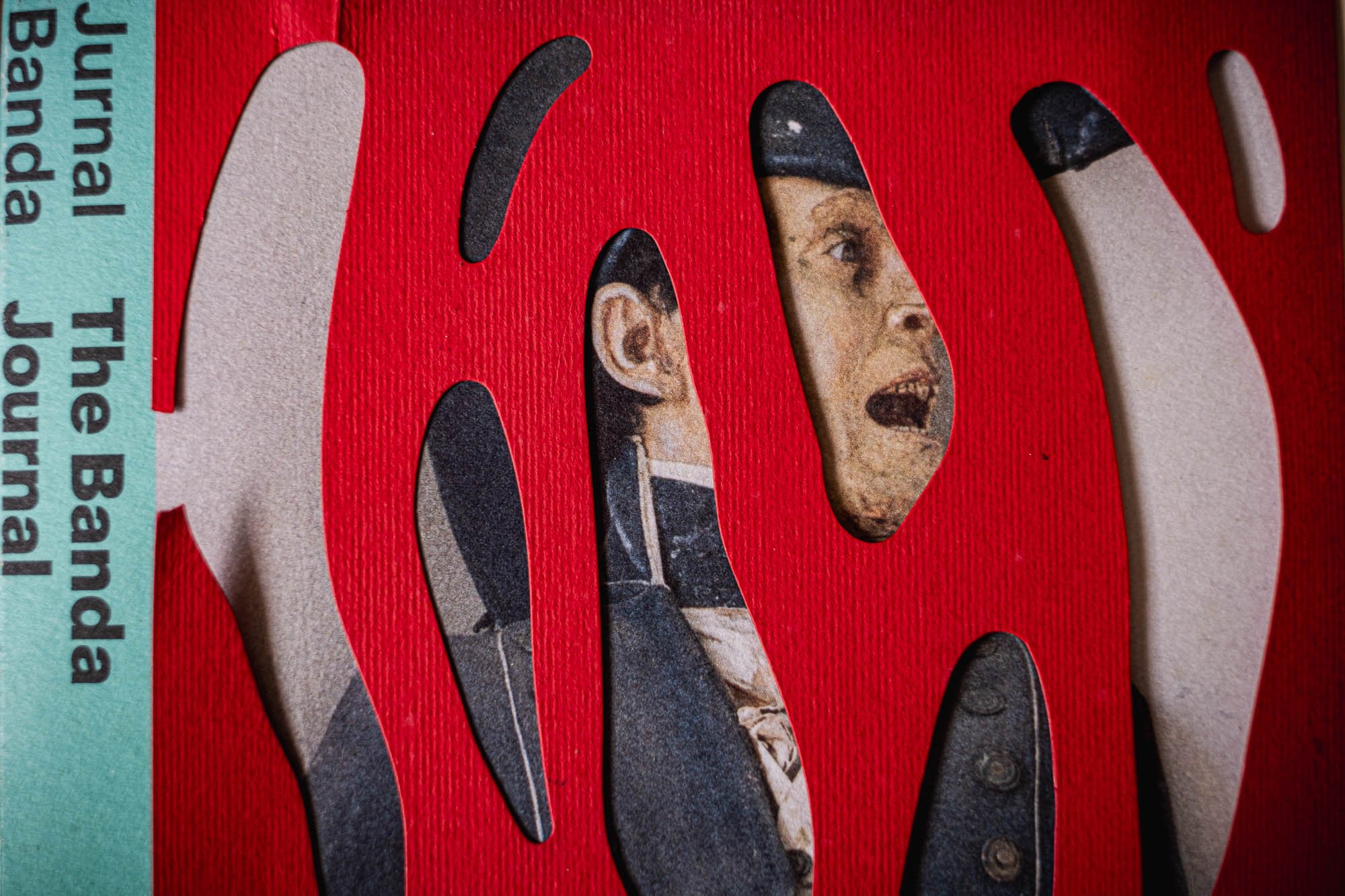
As if to illustrate this; Fadli’s photograph of a statue, a figure of the English Captain Sir Christopher Cole. This is a strange image of a strange relic. The statue’s mouth stands open, forever frozen in a rictus cry, the weapons he perhaps once held in his hands no longer there. The statue’s crotch is a gaping hole, shattered, intentionally or by the passage of time. Who can tell? Either way this once war-like figure now stands impotent and neglected.
In the decades following the massacre of 1621, the Banda Islands continued to be fought over. Following a successful attack by Cole on the Dutch controlled islands, the English transplanted nutmeg to their other colonies. As nutmeg came to be cultivated elsewhere, spread by competing colonial powers into their territories, this more widespread cultivation would come to undermine the market value that had caused so much bloodshed. The photograph of Cole’s statue graces the cover of the book’s 1st edition, wrapped in a graphic representation of the red mace, the protective webbing covering the nutmeg seed, also known as aril. Could this be read as a commentary on the colonial power’s desires and excesses becoming a trap, and eventually their own undoing?


Among the many portraits of the islanders, There appears a photograph of two elementary school children – Riska and Dewi, pictured in their school uniforms. Their home is the island of Rhun, once claimed by the English and traded in a treaty of 1667 for the island of Manhattan in the Americas, claimed at that time by the Dutch. The indigenous peoples of either island were doubtless not consulted.
A straightforward image, perhaps, until we later encounter the same pair standing in a similar pose, this time wearing their ordinary clothes, which blend into the palette of bark and fallen leaves of the nutmeg plantation that surrounds them. There is a suggestion here of how people can be both of a place, and yet stand apart from it. What opportunities has history afforded them?
Rhun. Manhattan. Two islands, thousands of miles distant, with overlapping histories of imperial conquest. Could it be something more than coincidence that both islands would have an outsized influence on global history? This connection is eloquently expressed by Fatris MF as he writes of a stay in Abdulah Lapari’s ‘Manhattan 2 Guesthouse’ on the island of Rhun:
Night came and Manhattan Guesthouse was flooded with light, at least for the next few hours. When it was almost bedtime, the power went out, plunging Abdulah’s inn and all of Rhun Into Darkness. It wasn’t just darkness that enveloped the island but also a stifling cloud of hot air. Outside the guest house, a drunken man was babbling in the dark.
Almost a century after Thomas Edison invented the light bulb, Rhun was still spending nights in the dark. In my room, the humidity crept in. As I lay in bed sweating profusely, the aroma of Mace wafted into my nose and haunted me all night. Eventually I fell asleep bathed in sweat but cloaked in perfume – the smell was so insistent I ended up dreaming of nutmeg.
Many people today know Manhattan, and some have even visited it. But not Rhun. At a time when Manhattan is full of sleepless skyscrapers, boutiques, universities, art galleries, restaurants and bars, Rhun only has some modest houses, macadam roads, eight motorbikes and two junior high schools. Manhattan symbolises the promised land for millions of hopeful immigrants, while the tiny, far-flung third world island only has around 1300 souls. Rhun’s fame has faded to the point where The Times Atlas of the World has forgotten its existence. In the past, this island was drawn even before the world map was complete. Is there still a country willing to barter its land with Rhun?


Today the Banda Islands exist in relative economic poverty, while Western colonial powers still enjoy the privileges of that historically extracted wealth. Who then benefits from the prosperity that is the promise of a capitalist society? Who can claim ownership?
The complexity of the story told in The Banda Journal only increases as we follow its many threads, yet the events that occurred on Banda hundreds of years ago seem to exist at a point of concentrated historical significance.
Perhaps every generation feels that it lives in a significant age, and must name it. With undeniable self-importance we have begun to refer to the age we live in as the Anthropocene. Yet, the origin date of this era seems to depend on how one imbues historical markers with meaning. Did the Anthropocene begin with the transatlantic slave trade, the rise in carbon emissions in the industrial revolution of Western Europe? Or did it begin more recently, with the spike in radionuclides as the atomic age began, or as far back in human prehistory when agricultural settlements began to proliferate?
Or perhaps, as David Graeber and David Wengrow argue in The Dawn of Everything, the progress of human history is less linear and more entangled. While scholars of different disciplines argue over epochal endings and beginnings, we could perhaps in the meantime refer to anthropogenic markers; important waypoints on the path along which we centre ourselves.
The Massacre of the Orang Kaya in Banda in 1621 could be one such marker. A point in space and time around which trajectories converge and pivot. Discussing these events is key, when some of us have only just begun to reach back and find alternative voices in the retelling of our collective history, one not written exclusively by conquerors.
Education provides an opportunity to do just this. Fatris MF tells us of how he gave students at Tanah Rata Junior High School in Banda an assignment to write letters, a selection of which are published in The Banda Journal. While relating this, he tells us of a student in a school in Naira who had drawn a map of Indonesia with an enlarged version of the Banda Islands “using lines and colours that were firm but messy. It was as if the map wanted to shout, proclaiming that Banda had to be written clearly and that not even one island should be missed out”.

It is documents such as The Banda Journal that help us in that vital task bringing the atrocities of colonial expansion, and the warped ideology of the men who founded companies such as the VOC into our present day. In the words of Amitav Ghosh, these are men who “[…] prided themselves on their rationality, moderation, and common sense. Yet they pursued a policy that perfectly illustrates the unrestrainable excess that lies hidden at the heart of the vision of world-as-resource – an excess that leads ultimately not just to genocide but an even greater violence, an impulse that can only be called ‘omnicide,’ the desire to destroy everything. ”
If this sounds overly dramatic, one only has to look at the exponential increase in environmental damage related to human activity. This is occurring despite clear, rational evidence that it could ultimately lead to a cascade of ecosystem collapses, with potentially disastrous consequences for our globally integrated societies. This is not some egregious by-product of “bad” capitalism, it is in fact fundamental to the system.
We will end then, as we began, somewhere in the middle, this time with an excerpt from The Nutmeg’s Curse:
You cannot relate to Gunung Api as the Bandanese did unless you know that your volcano is capable of producing meanings; you cannot relate to Dinétah as the Diné did unless the Glittering World glitters for you too.
“The planet will never come alive for you unless your songs and stories give life to all the beings, seen and unseen, that inhabit a living Earth— Gaia.
This story of Banda is far from over. The plants that still bear fruit, the people who live there, who we meet in Fadli’s photographs and in Fatris’ words are of a particular time, yet they live in a historical continuum, as do we all. It is through stories that we record and remember, and give us the opportunity to become more than passive objects of history; to pull on the threads of the complex network of connections, and perhaps shift the trajectory of possibilities.
Acknowledgements
In the writing of this I am indebted to Amitav Ghosh’s The Nutmegs Curse and remembered conversations with artist Beatrice Glow around her projects Rhunhattan and Empire of Smoke for inspiring and clarifying my thoughts on linkages and associations between Empire and Capitalism that are far from linear.
Fatris MF & Muhammad Fadli
Jurnal Banda | The Banda Journal
Jordan Jordan Edition (First edition, 2021)
Indonesia and English (bilingual)
ISBN: 978-1-7354521-0-4
https://www.muhammadfadli.com/the-banda-journal
Further Reading
Interview with Muhammad Fadli on matca.vn
Interview with Muhammad Fadli on c4 Journal
Paris Photo-Aperture Foundation 2021 PhotoBook Award announcement
Amitav Ghosh, The Nutmeg’s Curse
John Murray 2021
ISBN: 1529369436
David Graeber and David Wengrow
The Dawn of Everything: A New History of Humanity.
Allen Lane; 2021
ISBN: 0241402425
An extensive bibliography can also be found in the Banda Journal itself.
Tom White has spent the last twenty years working in the fields of art, media and academia. He is a visual communications educator, as well as a photographer in the journalism, editorial, advocacy and commercial spaces. He designed and delivered the Photojournalism & Documentary curriculum for Yale-NUS College in Singapore, and has also taught at the International Center of Photography and Columbia University in New York, in addition to instructing and facilitating various workshops and community-based social programs. Tom’s current research includes a focus on the potential of immersive and interactive documentary methods, and the continued importance of visual and media literacy. He’s been based in Singapore since 2011.