Photos and Text by Sai ▇▇▇▇▇.
On 1st February 2021, Myanmar was seized in a military coup. On that day, I went into hiding. The country’s de facto head of state, Aung San Suu Kyi, senior figures from the National League for Democracy (NLD), and regional government leaders were arrested in early morning raids. My father, an NLD member and Chief Minister of Shan State, Myanmar’s largest administrative division, was one of those who were taken.
For 165 days, my father was held hostage, interrogated, and tortured in an unknown military compound. Eventually he was transferred to a COVID-infected prison on bogus charges of corruption, facing a sentence of more than 60 years. My mother clung to the belief that he would be released, as he was innocent. I told her that it would not happen. I tried to prepare her for what I knew would come next.
My wife and I hid for months, supporting the underground revolutionary movements spreading like wildfire through the country. Eventually we returned to the Chief Minister’s compound in Taunggyi to see my mother. She had been there under house arrest since the coup, all alone.
We knew that if we were caught we risked arrest, torture, and even death.


My plan had been to take a family portrait at the end of his term in office, in March. It was not to be, but his presence was still there. A space with white string was left for him in the portraits, and our faces are protected by fabric woven in the style of a traditional Shan carpet but created from the clothes of political prisoners abducted by the regime. These are the trails of absence.

My plan had been to take a family portrait at the end of his term in office, in March. It was not to be, but his presence was still there. A space with white string was left for him in the portraits, and our faces are protected by fabric woven in the style of a traditional Shan carpet but created from the clothes of political prisoners abducted by the regime. These are the trails of absence.

My plan had been to take a family portrait at the end of his term in office, in March. It was not to be, but his presence was still there. A space with white string was left for him in the portraits, and our faces are protected by fabric woven in the style of a traditional Shan carpet but created from the clothes of political prisoners abducted by the regime. These are the trails of absence.

My plan had been to take a family portrait at the end of his term in office, in March. It was not to be, but his presence was still there. A space with white string was left for him in the portraits, and our faces are protected by fabric woven in the style of a traditional Shan carpet but created from the clothes of political prisoners abducted by the regime. These are the trails of absence.

Father’s Mood board. Quotes and images that he loves. Some are more than 20 years old, some are screenshots he printed from his phone. John Lennon, George M. Cohan, Fables of Aesop, Ajahn Chah, environmental protections, saving Irrawaddy dolphins, Maxwell Maltz, Buddhist philosophy. Things near and dear to his heart.

Right now, there is only my Mom and my Grandma. I was really sorry that I couldn’t stay behind to take care of them. While I was there, my father luckily managed to get a phone call through a sympathetic guard. He told me to escape. His exact words were, “you are a suspect because you are my son.” My mother decided that me getting out of Myanmar is best for the family.


My plan had been to take a family portrait at the end of his term in office, in March. It was not to be, but his presence was still there. A space with white string was left for him in the portraits, and our faces are protected by fabric woven in the style of a traditional Shan carpet but created from the clothes of political prisoners abducted by the regime. These are the trails of absence.


My mother felt better when I was there. We spoke until 4 in the morning, planning for several eventualities, including our deaths—we knew we could be killed if we were found. Through a sympathetic guard at my father’s prison, I heard that I was being hunted by the military. But my wife and I managed to leave after five days, heading back into hiding.
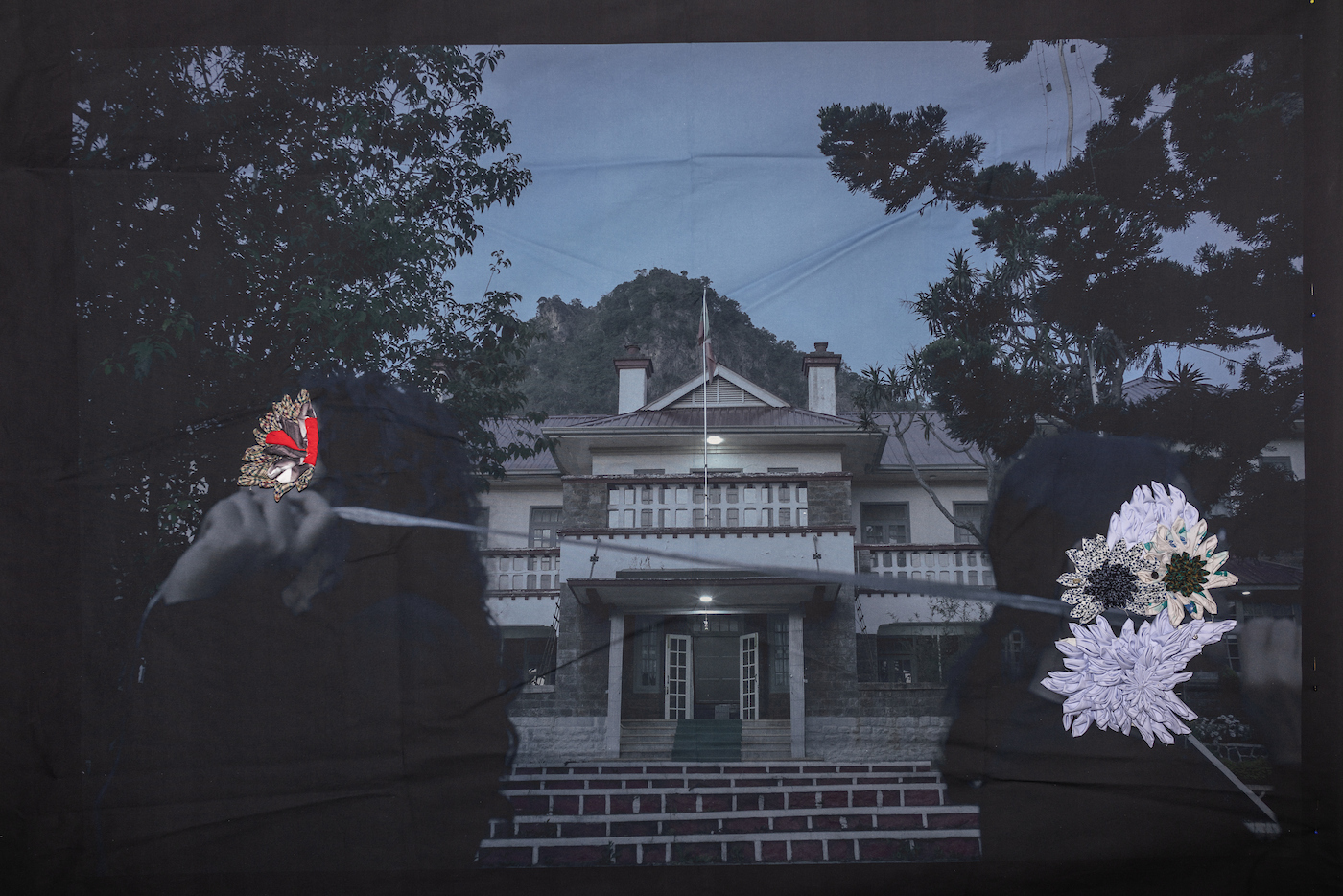
My plan had been to take a family portrait at the end of his term in office, in March. But it was not to be. Inside the compound I found traces of my father—his presence, his shadows—scattered everywhere, without knowing where he had been taken. In each of the photographs, a white string marks the space my father would have occupied if he had been in them. My mother’s face and mine are protected by fabric, woven in the style of a traditional Shan carpet, but created from the clothes of political prisoners abducted by the regime. These are the trails of absence.
This work is supported by grants from the VII Foundation and The Frontline Club.
Sai ▇▇▇▇▇ is a Burmese multidisciplinary artist. His ongoing work follows the political turmoil that has engulfed Myanmar since the coup of 2021 and specifically the trauma inflicted on his own family, exploring the unjust narrative of the relationship between his father, who has been held as a political prisoner by the Burmese junta since the coup, and his mother, who lives under 24 hour surveillance and in constant fear for her own safety. Sai himself has been in hiding for almost a year and has received numerous warnings that he is being sought by the junta because of his family’s political connections.
Due to the political situation in Myanmar the name Sai is an alias and this bio has been heavily redacted to remove any identifying information.
Sacca Photo represents a collective of photographers documenting the reality of life under Myanmar’s military dictatorship. All enquiries into licensing images for publication or exhibition should be emailed to saccaphoto@protonmail.com.