Text and photos by Tom White

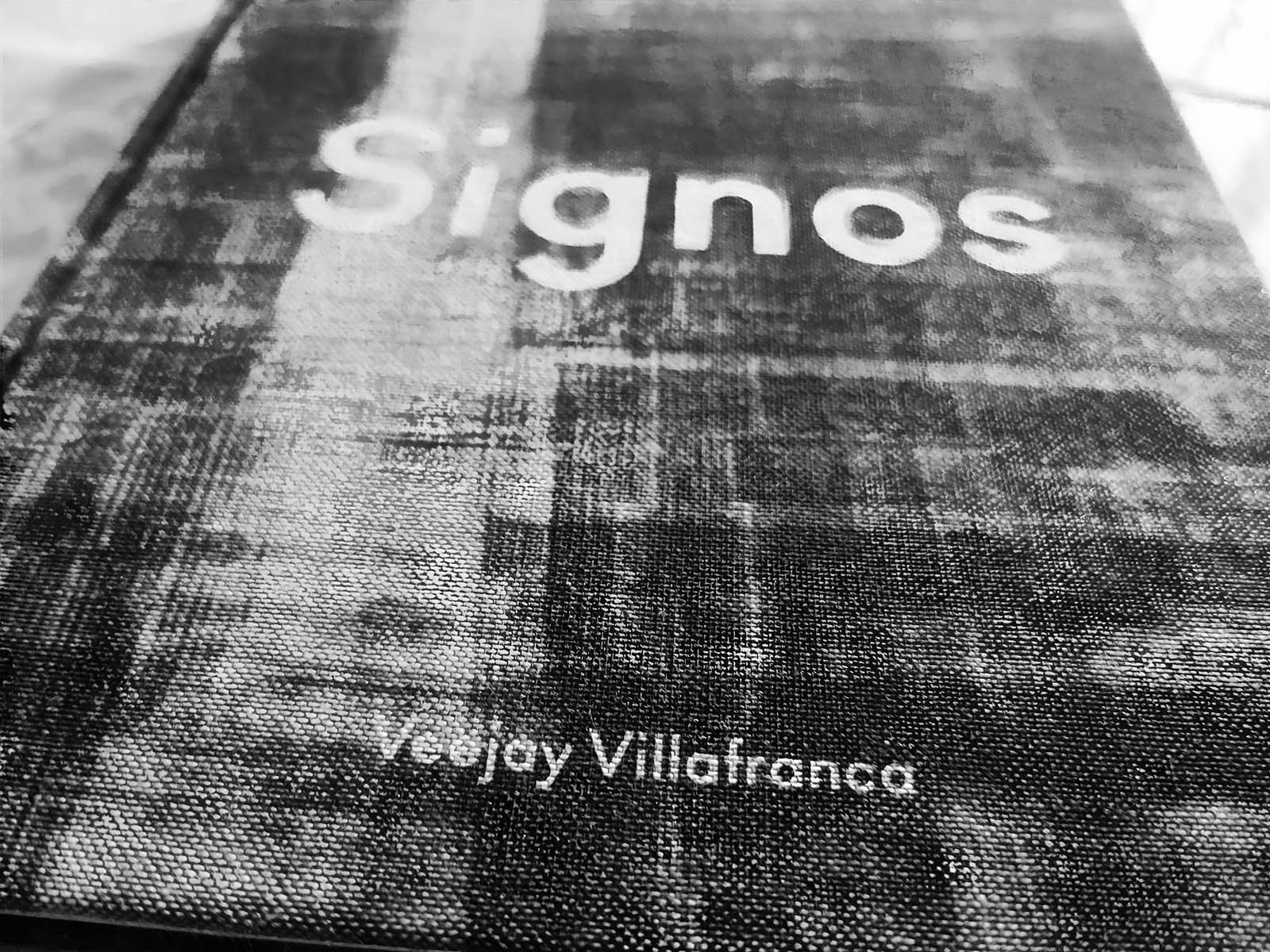
Signos begins with the story of a harrowing premonition in the form of a child’s drawing, made a day before Typhoon Haiyan devastated the islands of Leyte and Samar in the central Philippines. It is related to us in the book’s introduction by Filipino Professor of Art Studies and curator Patrick D. Flores, who then writes of grief and loss, palimpsests and tempests, remains and ruin.
Haiyan and its effects were an international news story for a time, and while this particular storm anchors Signos, the images move far beyond the news cycle.
Flores quotes Villafranca as saying that “it was the idea of displacement that pushed me to pursue this project” and this becomes the basis of the introduction’s narrative thread, ‘Dispersed by Torrent and Gathered by Image’.
We are confronted by layers of chaos from the very first image, foregrounding the tactility that pervades the rest of the book. Dank floodwaters, sweat on humid skin, scratch of twisted metal and splintered wood. The smell of burning, dust and smoke. Destruction and death.

It is a layered, chaotic montage. The black and white of the photography gives the wreckage of this storm-churned world a nightmarish sheen. You feel like you could brush it away, scratching it from the matte of the paper, smearing it with your fingertips whereupon the residue of the photograph would remain as an indelible stain.
It is a synaesthetic experience.
There is also life amongst the flood: A Marian procession faces a group of ladies charging their phones from a single power strip. Scenes from Baguio city literally unfold beneath these two contrasting moments. The bustle of a metropolis, the sound of life and joy and business-as-usual. We then turn the page to a kind of silence. A broken city scene the caption describes as “floodwaters settling and residents returning,” but here is only one solitary figure in this unsettled wasteland.


Beyond the physical wreckage there is an unfolding psychological violence. In an image of evacuees being transported weeks after Haiyan’s landfall, Villafranca positions the viewer as the rescuer, yet even this perspective fractures as we look out through the skeletal frame of the cargo plane, through the crowd to the apocalyptic landscape of splintered palms beyond.
The photographs draw us in with the same heaviness that causes a stilted building a century old to lean with age and damage, away from the solidity and stability it had promised for so many years, even as it still gives shelter from a tidal surge.
Time unfolds the trauma in this narrative. The photographs draw us in with the same heaviness that causes a stilted building a century old to lean with age and damage, away from the solidity and stability it had promised for so many years, even as it still gives shelter from a tidal surge. Turn the page and this building crashes into the violence of a child’s doll forced against the fence of a maternity house. A young child crouching in the background casts their gaze directly at us, just as the doll’s lifeless bodies avert theirs. We enter a room in a government health facility, and the light screams through the quiet of a waiting patient. This internal pain is made visceral, the silence of the photographic image increasing its intensity.
The narrative is relentless.


In Power of Gentleness: Meditations on the Risk of Living, philosopher Anne Dufourmantelle writes: “There is a brutality in the conditions of material survival: there is a spiritual and emotional desert where beings are trapped.” Dufourmantelle also reminds us that “living is a conquest wrenched from this passion of loss.”
How then do people find a way to live amongst these ruins? Yet of course, they do. Children still play. Life prevails. The oft-cited resilience is inevitably present in these images, set against a backdrop of exhaustion. These people are resilient because they have no choice. As climate change disrupts and destabilises, it is frequently the lives of the most vulnerable that the waters break over, that the storm rips and tears at. They become nameless victims, statistics, unidentified bodies in an overgrown graveyard.
Signos is dedicated to the memory of all the victims of such storms in the Philippines and as such it stands as an important testimony.

Villafranca is an accomplished photojournalist, and also an advocate of the inclusion of the personal voice. He balances the objective and the subjective eye with complex compositions and narrative layering to break photojournalistic convention.
Overlapping frames, montages and juxtapositions push the book beyond a visual document of the facts and figures: 1.9 million homeless, over 6 million displaced, billions of pesos of damage in infrastructure and livelihood. Villafranca shows us the intimacy in the lives of the affected, the lasting mental health issues and societal ruptures, the fear and pain and the moments of joy throughout the continued struggle.
As climate change disrupts and destabilises, it is frequently the lives of the most vulnerable that the waters break over, that the storm rips and tears at.
Poverty amplifies the effects of climate change, and in many ways the voice of Signos is the resigned cry of desperate resilience: “In the face of all of this we survive.” Yet, Signos is a narrative of aftermath, of afterimage. There are ghosts that haunt the survivors.
In its narrative structure, Signos carries little of the earnestness of the single news image, with its pathos and its appeal to the senses that ‘something must be done’. The images in the book that could be said to do this are complicated by the others that surround them.

What pervades is an overriding melancholy; the pain of people who have little agency in the face of a devastating typhoon and unrelenting climate change, too often described abstractly as a challenge for our society and for our politics. For many, climate change is not a challenge, it is an effect.
In a time of political and economic uncertainty, the lingering effects of a pandemic, and the climate emergency, it is increasingly the voices of the historically dispossessed that are highlighting the problems and finding the solutions. It is these voices that need sustained and material support.
I have witnessed first-hand how people living in informal housing along the coast of Indonesia, matter-of-factly state how their houses become inundated with flood waters, pointing out the high-water mark halfway up the wall inside their homes; the homes in which they sit to tell these stories. There is an acceptance that what happened before, may happen again.

Such people do not live lives of conspicuous consumption. There is very little they can do to diminish their personal carbon footprint. Facing ‘the challenge’ of climate change requires a systemic reconfiguration, which many people – many countries – do not have the means to address. Often this is because what common wealth their nation does possess has been extracted, enriching those who already wield economic and political power; what David Harvey calls “accumulation by dispossession.”
Science predicts that the proportion of intense storms of this nature will increase, as will the intensity of the strongest storms. What we see on the frontlines of climate change is that those who have the least, lose the most, first. For many, the places in which they live are continually edging closer towards being inhospitable, difficult, hostile. But we are all facing the effects of increasing temperature, environmental destruction and a disrupted climate. None will escape.
It is said that there is no such thing as a natural disaster. In 2021 the UN Secretary-General’s Special Representative for Disaster Risk Reduction, Mami Mizutori noted:
The world – low income and middle-income countries in particular – is being devastated by a mistaken notion of human progress. The global use of fossil fuels, the lack of international cooperation in support of developing countries and their health systems, the destruction of the environment, unplanned urbanisation and unchecked poverty are all driving up the frequency and intensity of disaster events.
Documentary and journalism is frequently criticised for depicting problems without offering solutions. We need to look at how photographers approach issues, and if it is enough to just ‘raise awareness.’ We need to be more intentional in creating the connections that photography can serve, so that together, we might find the solutions that none of us can accomplish alone.
1.9 million homeless, over 6 million displaced, billions of pesos of damage in infrastructure and livelihood.
Signos resonates with the experiences of those grappling with the ramifications of climate change, and offers a powerful testament to the inestimable cost of negligence. It reveals the pressing requirement to not only mitigate and adapt but also to address the root causes, and to heal from the already inflicted trauma.
What Signos shows us is not just how things are, it gives us a glimpse of how things feel.
Further Reading
- Remembering Yolanda: SIGNOS, by Veejay Villafranca (Invisible Photographer Asia)
- Signos by Veejay Villafranca (Robin Titchener)
- Living in Typhoon Country (Vantage)
- Philippines: Ground Zero for Climate Disaster (Time)
- Veejay Villafranca (Asia Paper Camera)
- Signos / Veejay Villafranca (from publisher MAPA Books)
Book Details
Signos
Published 2017 by MAPA Books
Edition of 700
195 x 226 mm. 144 pp.
ISBN 978-0-9956449-1-5
Photography: Veejay Villafranca
Edit: RJ Fernandez, Teun van der Heijden, Veejay Villafranca
Design: Teun van der Heijden, Heijdens Karwei
Tom White has spent the last twenty years working in the fields of art, media and academia. He is a visual communications educator, as well as a photographer in the journalism, editorial, advocacy and commercial spaces. He designed and delivered the Photojournalism & Documentary curriculum for Yale-NUS College in Singapore, and has also taught at the International Center of Photography and Columbia University in New York, in addition to instructing and facilitating various workshops and community-based social programs. Tom’s current research includes a focus on the potential of immersive and interactive documentary methods, and the continued importance of visual and media literacy. He’s been based in Singapore since 2011.